Recent Updates Page 101 Toggle Comment Threads | Keyboard Shortcuts

  • Roberto Galoppini 6:25 pm on June 11, 2007 Permalink | Reply  

    Open Source Conference: Commercial Open Source conference 

    The first edition of the Festival of Innovation, held in Rome from the 7th of June to the 10th, yesterday guested the Commercial Open Source Software conference.

    I introduced Bruce Perens saying that the expression Commercial Open Source is far from being an oxymoron, considering that commercial means either something oriented toward profit or pertaining to public trade or dealings.

    Festival dell'Innovazione Festival dell’Innovazione

    Bruce was scheduled to deliver the opening keynote speech, and despite he was almost voiceless because of many previous events, he brilliantly managed to introduce the audience to Commercial Open Source. He started giving some background information on his life and works, and then invited people to consider the economic Function of software. As a matter of fact only 30% of US programmers are working by software companies, so most of the companies involved with software development are not in the business of software manufacturing. In other words Enabling technology, in other words, in his opinion it is not the profit-center, but a cost-center.

    There are two main forms of enabling, cost-center technology: differentiating, and non-differentiating. Differentiating technology is what makes your business more desirable to your customer than your competitor’s business. [..] So, for Amazon, the “recommendation” software is a business differentiator. Obviously, it would be a mistake to Open Source your business differentiators, because then your competitor’s business might use them to become as desirable to the customer as your own business. [..] Perhaps 90% of the software in any business is non-differentiating. Much of it is referred to as infrastructure, the base upon which differentiating technology is built.

    On friday afternoon Bruce raised up the same topic by FIDAInform, the National Federation of the Associations of Information Management Professionals, where he had an argument with a member, a Microsoft employee. Their discussion, while not lacking of mutual criticism, was of great interest to the audience, and Bruce eventually reported the differences existing between the two different business models also on Saturday.

    Generally the initial development is done by a single entity as in the in-house and contract development paradigm, and the software is released to the public as soon as it is useful to others, generally before it would be considered a finished product and thus much earlier than a retail product would be released. [..]

    The cost and risk of developing the product is distributed among these developers, and any combination of them can carry on the project if others leave. Distribution of cost and risk begins as soon as the project is mature enough to build a community outside of its initial developer.

    On a different line Gabriele Ruffatti, Engineering’s legal representative in the ObjectWeb Consortium and a member of the SpagoBI & Spago projects board, gave a speech describing a different approach. Engineering is a large Italian IT firm employing about 3700 people – consider that only 0.4% of Italian IT firms employ more than 500 people and about 97% employ less than 10 people – and the System Integration represents more than 50% of their business.

    In his opinion a commercial open source product is:

    a solution claiming to be open source, claiming to have a community supporting it, but offering closed add-ons for enterprise adoption with a proprietary approach to the market.

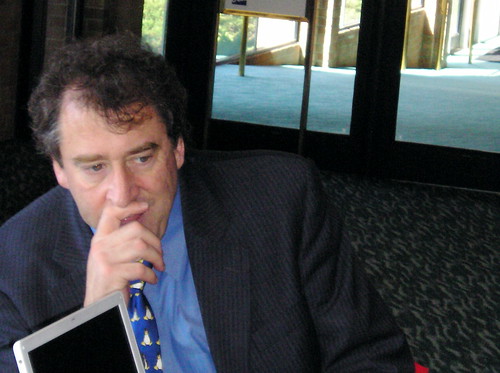
    He also added that Engineering have chosen the LGPL license, somehow implying that double-licensing doesn’t make much business sense to them. Bruce, that was totally voiceless at that stage, was disagreeing writing comments on his laptop, since he believes that double-licensing makes sense.

    On behalf of the Italian Consortium of FLOSS firms, Carlo Daffara spoke about the importance of Open Source Selection, bringing the experience of well known European project like COSPA – the Consortium for Open Source Software in the Public Administration – and OpenTTT.

    Emanuela Giannetta – Sun Microsytem Italia – started her speech mentioning OpenSolaris and Java, to eventually tell the audience about two Italian initiatives. JOB, an Italian portal created by her boss Franco Roman, and JikiBloom, a platform sponsored by Sun Microsystems Italia integrating a number of opensource projects, like Asterisk, Hylafax, Jboss, Pentaho, SugarCRM, Zimbra and others.

    Pierpaolo Boccadamo – Microsoft Italia – gave a speech talking about the importance of Intellectual Property in the digital age – and he got few questions from the public in this respect – and eventually told that Microsoft is going soon to open its second Port25 Lab – the Microsoft Open Source Software Labsomewhere in Italy.

    Last but not least Bruce spent few words talking about Software Patents and Open Standards.

    People from the public posed some questions to the panelists, ranging from Interoperability to patents, and among them Davide Gorini, Director of the first Italian Open Source Incubator, based in Rome, asked Bruce about Open Source Government policies. Bruce stated that in his opinion the law shouldn’t oblige to use open source software, but it has to be mandatory its evaluation. As he clearly explained, Public Administrations should make their choices considering technical merits and also valuating the impact of Open Source paradigm itself.

    Many Thanks to LAit – Lazio Technological Innovation – for the perfect organization and for the gorgeous location chosen for the event!

    Technorati Tags: Perens, Rome, Open Source Conference, Jikibloom, Spago, CIRS

     
    • gabriele 9:07 pm on June 12, 2007 Permalink

      To be as much clear as possible:
      1) in the OSS domain a lot of commercial solution claiming to be …, claiming to have … exist (it’s not the definition of commercial OSS)
      2) Engineering has chosen the LGPL license just for the SpagoWorld (www.spagoworld.org) initiative, not in general.
      3) double licensing doesn’t make sense to SpagoWorld. It could makes sense in other business models, but in many situations it’s just a little differentiator from proprietary model

    • Roberto Galoppini 1:24 am on June 13, 2007 Permalink

      Gabriele I am glad you didn’t mention to bring a new definition of what commercial open source is, but that’s also what I read. If this is not the case, you better ask them to change it.

      Spago, SpagoBI and also Spago4q are all distributed under LGPL, and you also mention that LGPL was chosen in order to let it accepted by a consortium, am I right? Could you tell us more about it?

      3) double licensing doesn’t make sense to SpagoWorld. It could makes sense in other business models, but in many situations it’s just a little differentiator from proprietary model

      I don’t know what business model suites SpagoWorld, but it can’t be true that double-licensing be often meaningless. If this was the case OS firms adopting the double-licensing wouldn’t sell it, right?

    • gabriele 8:19 am on June 13, 2007 Permalink

      Roberto,
      fine blogger. You have caught me in another blog. Anyway, no new definition (a blog is not the real place to manage such a discussion), but just my feeling, also collecting feedbacks from users and customers.
      GNU LGPL license was the first choice of ObjectWeb Consortium http://old.www.objectweb.org/. I share the same envision such as: build a strong solutions free (libre) to everybody, forced to be free in time enabling its growth by community efforts, permitting at the same time industrial adoption. Now ObjectWeb has moved to OW2 Consortium http://www.ow2.org, with no restrictions about licenses adoption (e.g.: some solutions are dual licensing), but fostering the same envision.

    • Roberto Galoppini 7:32 pm on June 13, 2007 Permalink

      Gabriele, thank you to make clear your position about commercial open source, I really appreciate it.

      About the “old” Objectweb policy, I actually notice that all the projects, but one, were distributed under the Lesser GPL. Curiously enough the one missing, sinc4j, being distributed under the GPL license allowed Funambol to fully take advantage of a business model based on double-licensing.

      By the way if you never got the chance to read it before, I would recommend you to have a look at “Why you shouldn’t use the Library GPL for your next library“. It is an old document but it still makes sense.

    • gabriele 6:55 am on June 14, 2007 Permalink

      Roberto,
      it’s an old question. Anyway, not only sinc4j adopts dual licensing in OW2 Consortium: different business models … I’m looking at the long term. I don’t like to open the debate about GNU LGPL: our different positions are very clear and I’m quite surprised that you, fostering commercial solutions (I suppose for enterprise adoption) have such a position about GNU LGPL. Please, have a look here: The LGPL is good for you Obviously, I agree with Stefano.

    • Roberto Galoppini 10:04 am on June 14, 2007 Permalink

      Gabriele,

      it is just because I am talking about Commercial Open Source that I advice not to use LGPL for business, unless you are willing to get other vendors to use it in their proprietary solutions. By the way, I cited Richard’s article because it makes clear that if your “library” has unique features you better consider using the GPL:

      This is why we used the Library GPL for the GNU C library. After all, there are plenty of other C libraries; using the GPL for ours would have driven proprietary software developers to use another–no problem for them, only for us.

      However, when a library provides a significant unique capability, like GNU Readline, that’s a horse of a different color.

  • Roberto Galoppini 11:58 pm on June 7, 2007 Permalink | Reply  

    Open Source Links: 07-06-2007 

    Introducing Office Excel and PowerPoint Translators – M2 is available now, the post includes also the roadmap, published in .doc format!

    Standalone open source software market reaches £900m – The standalone market was worth £900m last year, with further acceleration in take up expected this year, said analyst IDC.

    Welcome to MTOS: the Movable Type Open Source Project – The Movable Type Open Source Project was announced in conjunction with the launch of the last beta. OpenLogic reports that many in the blogosphere have said that Six Apart has been forced to move to open source because its largest competitor is open source. I am among them, blog platforms basically are a SaaS business.

    Anti-GPLv3 campaign has started – The latest draft of GPLv3 is out of the door, the anti-GPLv3 pieces start coming in, FSFE says.

    Open Source Hiring – This is good time to be an open source developer, have a look at Considerati’s job opportunities!

    Project Indiana: The Q&A – Stephen O’grady thinks Indiana is precisely the kind of change that’s needed to make OpenSolaris an option where it’s not today.

     
  • Roberto Galoppini 8:17 pm on June 6, 2007 Permalink | Reply  

    Open Source Hackers: the Italian blogosphere meets Bruce Perens! 

    The Italian blogosphere is invited to participate next Friday in a meeting with Bruce Perens, author of the Open Source Definition and well-known open source advocate.

    Open Source awareness is risking to be a clique phenomenon, resulting in open source advocates talking each other. Bruce Perens kindly welcomed the idea to meet Italian influencers to the Open Source.

    Bruce Perens Bruce Perens by GeorgeNemeth

    Bruce Perens will introduce himself telling us about his life as hacker, and we might learn from his voice about all different phases of the open source adoption.

    To join the meeting, scheduled for 10 a.m. (GMT+1) you just need to subscribe on pbwiki or upcoming setup by Nicola Mattina, who is helping me to make it happen.

    On Saturday I will also moderate the Commercial Open Source Software panel where Bruce will held the keynote speech, if you are an IT entrepreneur that is the place for you!

    Ernst & Young will guest our meeting by its office in Rome, Via dei Villini 13/15, many thanks to Andrea Paliani to make it possible.
    [open source, perens]

     
  • Roberto Galoppini 12:38 am on June 5, 2007 Permalink | Reply  

    Open Source Blogs: Commercial Open Source Software partners with OpenBusiness! 

    Christian Ahlert, project lead of Creative Commons England and Wales, few days ago kindly asked me to join OpenBusiness, a space aimed at sharing Open Business ideas built around openness, free services and free access.

    I am glad to contribute to an online resource of innovative business models, and I am looking forward to share knowledge and lessons from the commercial open source world.

    Join the club Join the club by WAXY

    Technorati Tags: Commercial Open Source, Open Business

     
  • Carlo Daffara 3:40 pm on June 4, 2007 Permalink | Reply  

    Open Source Production: not only code 

    Most people thinks that being “open source” means being coders or contributing patches, and it is still controversial how companies position themselves in the OSS market. Most people consider a company OSS when it contributes code to an OSS project, but nowadays a significant value of open source lies in non-code contributions.

    During previous research projects, I found several references to code contributions (and most online tracking services like Commits in Action or Ohloh but it is nearly impossible to find traces of non-code contributions. During the creation of the knowledge base of the COSPA project I found an amazingly well written report by the French Réseau National en Technologies Logicielles called “New economic models, new software industry economy” where I found a telling text snippet on the OpenCASCADE CAD framework:

    In the year 2000, fifty outside contributors to Open Cascade provided various kinds of assistance: transferring software to other systems (IRIX 64 bits, Alpha OSF), correcting defects (memory leaks…) and translating the tutorial into Spanish, etc. Currently, there are seventy active contributors and the objective is to reach one hundred. These outside contributions are significant. Open Cascade estimates that they represent about 20 % of the value of the software.

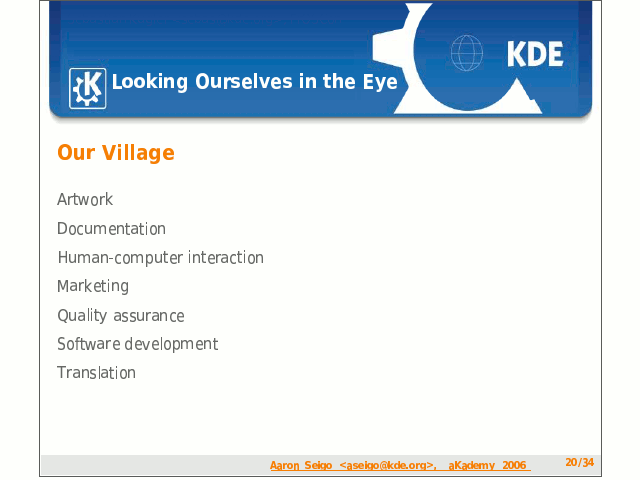
    This 20% is mainly non-code related, but it’s 20% of the project value nevertheless. This happens in a very vertical, and technical-oriented environment; but if we look at a highly successful open source project like KDE, we can find something like this:

    KDE From Aaron Seigo’s speech, in Akademy 2006

    Software development is just one of the tasks necessary to build a large scale, complex system like KDE, and I have no doubt that something similar applies to GNOME, Fedora or OpenSolaris.

    We should start thinking more about how to study non-code contributions, and how this relates to the commercialization of open source projects (and not only software).

    Technorati Tags: OpenCascade, Open Source Production, KDE

     
    • Ed Dodds 5:34 pm on June 5, 2007 Permalink

      I think this is why documentation and marketing are generally weak links in the OSosphere.

    • Antonio LdF 1:04 am on June 6, 2007 Permalink

      Do you already know me..
      I’m Antonio aka Forrest Camp; do you remember Rome and the barcamp?

      In these period I embraced completely the cause of my “Free Biz Projects” and I thought a lot.

      I use only open source software like Ubuntu, Gimp or Open Office.
      I would collaborate to implement them but I’m not a developer and I’ve no money to give.

      I’m a creative, I’m project manager and a marketing young man. I want to create a bridge between mktg and developers. I would help the open source to arrive to the main stream using approaches that probably the code contributors ignore or despise..

      The important thing is to search something that each one could do for open source and I would do everything in my power.
      Today I would send you a mail, but this comment is better!

      See you soon Roberto!

  • Roberto Galoppini 8:12 pm on June 3, 2007 Permalink | Reply  

    Open Source Links: 03-06-2007 

    Free Downloads vs. Sales: A Publishing Case Study – Tim O’Reilly tells an interesting story about Asterisks book, comparing free downloads vs sales.

    IDC values open source software market at $1.8bn – IDC has also predicted that the market will grow by a compound annual growth rate of 26% from 2006 to reach $5.8bn in 2011, by Matthew Aslett.

    Who pays for Open Source? Freemium conversion rates – Don Dodge correlates “Freemium” conversion rates to the ratio of OSS users paying for support contract. IS that a general rule? I doubt.
    How to select a CMS -  Seth Gotlieb wrote an insightful post about CMS selection, James McGovern commented and Seth eventually noticed that only some OS products have vendors behind them. The process, in this case, might be different.

    Alfresco and Liferay User GroupAlfresco and Liferay are hosting a CMS/Portal user group meeting in Ontario, Carlifornia on Wednesday July 18th.

    Microsoft and IronRuby – John Lam on IronRuby.

    Office 2.0 Conference Redux – The Office 2.0 Conference will be held in S.Francisco next September, if interested fill the registration form at discount price until July 14.

    Novell Open PR: ‘Last call’ draft of GPLv3 – GPLv3’s stakeholders and loopholes are still driving the draft review process.

     
  • Roberto Galoppini 5:42 pm on June 2, 2007 Permalink | Reply  

    Open Source Firms: EnterpriseDB business model 

    Talking about EnterpriseDB I used the expression “false positive”, but actually I didn’t provide any test to “detect” if a firm is or not an open source firm, and the community can’t be an effective analysis tool for this.

    Symbiotic Symbiotic relationship by georger_gilbert

    Researchers found a pragmatic answer, and I am start thinking is pretty correct, but judging firms by their actions could require some effort, though. Google for example is taking advantage of the GPL loophole, but it is also contributing to many projects, Google summer of code included.

    Creating open source firms’ categories reflecting the corporate-community relationship could be interesting, but complex distinctions might bring more confusion than clarity, I am afraid.

    Googling around I found Andy Astor – EnterpriseDB President and CEO – writing is just started blog, commenting “The EnterpriseDB license model“, pretty much about the EnterpriseDB business model.

    I firmly believe in the value of open source. There is no question that open source communities produce great software, and do so quickly and with extraordinarily high quality. Yet EnterpriseDB’s principal product — EnterpriseDB Advanced Server — is a closed source product. Why is that?

    The answer to this question is a little involved, but stay with me…I think the logic is actually pretty simple.

    Like all commercial organizations, EnterpriseDB is in the business of making money. When we created the company, we needed to define a mechanism of delivering value to customers for which those customers would be willing to pay. We originally planned simply to take the same approach as most other open source companies, which is a dual-licensing strategy.

    With a dual-licensing approach, the company is protected by a GPL (or similar) license, because both competitors and potential customers who wish to embed/link with the GPL software must also GPL their own code. Since most competitors/customers don’t wish to do so, they are willing instead to pay for a commercial license. This simple yet subtle point is at the heart of the success of nearly every commercial open source organization. I would be remiss (and Matt would surely bonk me on the head) if I didn’t also mention the value that these companies bring via their expert support and services. But the subtle yet powerful truth about commercial open source is that the GPL is an excellent enforcement mechanism for creating commercial value.

    Now, unlike most open source projects, which are licensed under the GPL or similar license, PostgreSQL is a BSD-licensed project. As most of you know, BSD is among the most permissive licenses, allowing anyone to do anything with the code, with virtually no restrictions. In other words, the BSD license provides no commercial protection whatsoever, either from competitors or potential customers. With the BSD, anyone can take the code and do anything they wish.

    So why not just change the PostgreSQL BSD license to GPL? Remember that, unlike most open source companies, EnterpriseDB did not create the open source project upon which it is based. The PostgreSQL community has been around for more than a decade, and is one of the most strongest and most independent open source communities in the world. EnterpriseDB does not control the copyright or the license to PostgreSQL, which means a dual license business model is simply not an option for us. PostgreSQL is BSD…period. And by the way, the PostgreSQL community strongly supports its staying that way.

    I am not sure EnterpriseDB would have ever considered using a double-licensing scheme, if possible. MySQL – the world’s most popular open source database – has a customers/users that is about 1/1000, and is popular by small-to-medium enterprises.

    EnterpriseDB (PostgreSQL) is not as popular as MySQL, and EnterpriseDB target audience is different, mostly medium-to-large enterprises, willing to pay for value added services. I believe that the Split OSS/Commercial product business model suites them very well, much better than double-licensing.

    So…what to do? How can EnterpriseDB create a business model that honors the PostgreSQL license and community style, while at the same time allowing the company to deliver value for which customers will pay? The answer is fundamentally a 2-part strategy:

    First, we created a superset of PostgreSQL called EnterpriseDB Advanced Server, and closed-sourced the code. In other words, atop base PostgreSQL, we added deep Oracle-compatibility, dynamic performance tuning, and world-class tools, including replication, debuggers, browsers, and more. Then we closed-sourced the whole package. In this manner, we have crisply defined a set of value-added features for which we charge, much like SugarCRM’s professional edition. If you want the free-and-open-source version version of the software, though, it’s easily available…and it’s called PostgreSQL.

    The second — and equally important — part of our business strategy is to be an excellent citizen in the PostgreSQL open source community. We are building a successful company on the shoulders of one of the world’s most successful open source projects, and we have a responsibility to give back to that community to the maximum extent possible, while still protecting our ability to generate revenue. In addition to our ethical responsibility, we also “do well by doing good” because we promote the wider spread of PostgreSQL, the world’s most advanced and enterprise-class open source database (albeit only the second most popular).

    Our efforts at being excellent citizens of the PostgreSQL community are wide-ranging, but tend to fall into the following broad categories:

    • Identify important and difficult development community projects, and get these projects done with EnterpriseDB staff
    • Employ community leaders, including both titled members (i.e., core team) and thought leaders
    • Sponsor non-employee community developers
    • Be a major sponsor of community gatherings and other activities

    This balanced approach of selling commercial software on one-hand and aggressively supporting the community on the other is our answer to the conundrum of creating a commercial company on a BSD code base. I think there have been some misunderstandings about our approach in the past, and I hope this clears them up.

    While I keep thinking that EnterpriseDB business model is not related to a license issue, I totally agree with Andy Astor, EnterpriseDB is an open source firm and… it is also adopting a symbiotic production model!

    Technorati Tags: Commercial Open Source, EnterpriseDB, Astor, symbiotic

     
    • Andy Astor 11:08 am on June 5, 2007 Permalink

      Roberto,

      thanks for noticing the blog entry. your post is absolutely right…we’ve tried to find a symbiotic relationship with the community. And it’s working so far.

      For the record, we definitely would consider a dual-licensing model, but the BSD license thus far is not compatible with that approach.

      Glad to start a dialog. All the best,

      Andy Astor, CEO
      EnterpriseDB

    • Roberto Galoppini 11:27 am on June 5, 2007 Permalink

      Andy,

      you’re welcome!

      I agree that the dual-licensing model works fine with the GPL, but I still think that addressing a smaller audience (compared to the MySQL’s one) you needed to use the Split OSS/Commercial product instead.

      Let’s talk about your symbiotic approach, I wish to know more about it.

  • Roberto Galoppini 7:19 am on May 31, 2007 Permalink | Reply  

    Open Source Events: Bruce Perens and Richard Stallman in Rome 

    The Innovation Festival, that will be held in Rome from the 6th till the 10th of June, will guest people from all around the world to talk about traditional and also unconventional routes to innovation. Richard Stallman and Bruce Perens will attend.

    Bruce Perens Bruce Perens by GeorgeNemeth

    Over the four days meeting, organized by LAit (Lazio Technological Innovation) I would recommend free software and open source enthusiasts to save the following two dates:

    8th of June, 8 pm: Free Software between Ethics and Business, open issues and success storiesAuditorium Ara Pacis, moderated by Arturo Di Corinto.

    9th of June, 10 am: Commercial Open Source Software (Panel) – Auditorium Ara Pacis, moderated by Roberto Galoppini. Bruce Perens, SourceLabs Vice President and Author of the Open Source Definition, will introduce the debate. Among panel participants Carlo Daffara (CIRS), Gabriele Ruffatti (Engineering), Pier Paolo Boccadamo (Microsoft), and Franco Roman (Sun).

    A Q&A session with the audience will follow, everyone is invited.

    Technorati Tags: Commercial Open Source, Perens, Rome, Stallman

     
    • Carlo Daffara 9:13 am on May 31, 2007 Permalink

      Many thanks to Roberto for spreading the news on the event. I will be probably present some results from the OpenTTT matching model for open source software, and eventually to talk about business models; I would be happy if anyone would suggest additional topics of interest.

    • Roberto Galoppini 10:39 am on May 31, 2007 Permalink

      Hi Carlo,

      I enjoyed your idea to talk about OpenTTT, is a pragmatic approach to open source.

      About business models – that I believe is a pretty interesting subject – to not be theoretical I will ask panelists to talk just about their actual business models.

    • Paolo Corti 7:01 pm on May 31, 2007 Permalink

      Hi Roberto
      I have definitely decided to be there the 9th, hopefully I will not have too much work that days…

    • Roberto Galoppini 7:11 pm on May 31, 2007 Permalink

      Paolo I really hope not, it is on Saturday! 😉

    • Luca Sartoni 9:26 am on June 1, 2007 Permalink

      I will be glad to take part at the event.

    • Paolo Corti 3:31 pm on June 1, 2007 Permalink

      Oopss, I didn’t realize it is on Saturday. I definitely will be there 😉

  • Carlo Daffara 3:38 pm on May 29, 2007 Permalink | Reply  

    Open Source Firms: What is an OS company, anyway? 

    A recurring theme of discussion is exactly what defines an “OS company”. Many potential customers are finding more and more difficult to distinguish between “real” open source, viewable code licenses, quasi-open and more; companies are trying to leverage the opportunity of the OS market to push an offering, even if it is not OSS at all.

    Recursion Recursion by gadl

    Of course, a company like Alfresco can proudly claim that – being its main offering a pure GPL software – they are OS, libre, and whatever. But what exactly makes a company an open one?
    It is not difficult to find previous traces of the same argument before; starting from Mark Shuttleworth’s comments, Aitken’s ones or by Savio Rodrigues. Within the FLOSSMETRICS project we are facing the same problem, that is how to assess the “openness” of a company, and we observed a few things:

    • an OSS project is not only about code; in fact, in many projects the amount of non-code assets (like documentation, translations, ancillary digital material) is substantial. Considering companies as open only by measuring code patches is reductive;
      .
    • a company may sponsor a project in many ways. For example, granting hired programmers time to work on OSS projects (during work hours) is an indirect monetary sponsoring activity; hiring main developers and giving them flexibility to continue develop OSS code is a direct sponsoring.

    There are relatively few examples of the first kind; among them, companies that localize and create country-specific versions (like the italian accounting scheme for the Adempiere ERP created by Anthas to allow for a simpler commercialization.

    The second model is quite common: IBM sponsors development of the Apache web server, as a basis of its Websphere product, Google employees are asked to work for an OSS projects one day per week on company time (and sponsoring the summer of code, by the way), EnterpriseDB pays many PostgreSQL developers.

    Given this, we ended up classifying OS firms as those that:

    • sponsor, support, facilitate an open source project, that is a project that has a license compatible with the OSD definition, in a direct or indirect way.
      .
    • the sponsoring/support must be continuous, that is it should not be a single, one time contribution.

    This allows to include only those companies that leverage OSS in an organic and structural way, or they would not be able to justify the investment over an extensive period of time.

    This excludes one-time donations, for example; and it also excludes those companies that just take OSS and resell it packaged without added value, or “dump” a worthless software code under an OSS license hoping that someone willtake it up from there.

    Technorati Tags: adempiere, alfresco, anthas, Commercial Open Source, Open Source Firm

     
    • Savio Rodrigues 6:22 am on May 31, 2007 Permalink

      I agree Roberto, defining an OSS company is difficult and going to get increasingly so as more companies add OSS into their software strategy.

      Something that I’ve been thinking about since OSBC, which relates to your post…

      We’ve all heard about how open source Google uses to run their business. We also know that Google pays (some of their) employees to work on OSS projects as part of their day jobs. But what of all the OSS changes that Google makes and does not contribute back to the community? Does that make Google a ‘bad’ OSS company? How can they be ‘bad’ when they’re using OSS in a way that the OSS license allows??? But really, we all know that Google can’t be bad/evil, right 🙂

    • Roberto Galoppini 11:53 am on May 31, 2007 Permalink

      @Stefano Maffulli: Stefano I couldn’t manage to comment your post (may be is it great time to become a FSFE Fellow in order to? ;-), so I am writing you here for the time being. Mission and CSR might help, but my guess is that it is more effective to judge firms by their actions, even if requires some effort.

      @Open Source Solutions: I guested Carlo’s post even if I previously took a completely different position on the matter, and now I am seriously wondering about it all.

      @Savio: you are raising the same point I early discussed with Carlo, amazing! 😉 We all know Google is taking advantage of the GPL loophole, but it is also true that is contributing to many projects, and we can’t also forget the Google Summer of code.

      I think we should start creating categories reflecting the corporate-community relationship, and also the “old” Externally funded”/ “Internally funded” models. But all these (complex) distinctions might bring more confusion than clarity, I am afraid.

  • Roberto Galoppini 7:57 pm on May 28, 2007 Permalink | Reply  

    Open Source Franchising: Sun asks for comments on Franchising! 

    Today is a great day, I eventually got Simon Phipps, Chief Open Source Officer at Sun, asking Red Monk – the first analysis firm built on open source – about franchising viability of open source services. Below the full story from the very beginning.

    Happiness Happiness by Estexx

    Thinking back to open source challenges described in 1999 by Michael Tiemann, more than one year ago I tried to figure out how to cope with some of them:

    • Scalability – How can a service-based business scale?
      .
    • Sustainability – Will Cygnus be around when customers need it?.
      .
    • Manageability – How can open-source software be managed to deliver quality consistently?.

    It has never been easy providing consistent answers to those questions, and the reason could be that no one had an insight that “open source diversity” – the (frequent) absence of a Corporate actor – would really matter.

    Writing down customers and vendors’ perspectives, Open Source Franchising came out almost as a natural response, and I started writing the OS franchising concept in March 2006.

    Highlighting why appropriating returns from the commons was critical, along with the user-driven demand of broad IT services in commercial open source software, helped me to figure out why Sun is the perfect Franchisor.

    Large companies’ and SMBs needs were discussed, showing how the first are more interested in Value-Added-Services and the latter are demanding basic services, addressable by franchisees.
    I also investigated the ideal Franchise, pointing out that start-ups are the best choice.

    To complete the concept I collected and discussed some analysis about the Italian OS market (IDC) and the global market (Forrester), concluding that boundaries of the opportunities space for OS outsourcing are pretty open.

    I eventually finished to write the concept two months later, and I gave the concept to Franco Roman, Director of Marketing at Sun Microsystems Italy, in May 2006. Franco shared the concept with Simon over summer, but I had to wait until November to speak with Simon in person, and and I am extremely happy to know that now Simon is taking my idea into very serious consideration. Things are starting to move. Go Simon Go!

    P.S.: It would be wonderful if James Governor and Michael Coté would lend themselves to start an open conversation via the comments area or their blogs on this important issue.

    [commercial open source, franchising, Sun, Red Monk, Phipps]

     
c
Compose new post
j
Next post/Next comment
k
Previous post/Previous comment
r
Reply
e
Edit
o
Show/Hide comments
t
Go to top
l
Go to login
h
Show/Hide help
shift + esc
Cancel