David Wheeler kindly suggested me to read the last number of the DoD Software Tech news – a periodic published by the Data & Analysis Center for Software – entitled “Open Source – The future is Open” (registration required), and it really worths reading.
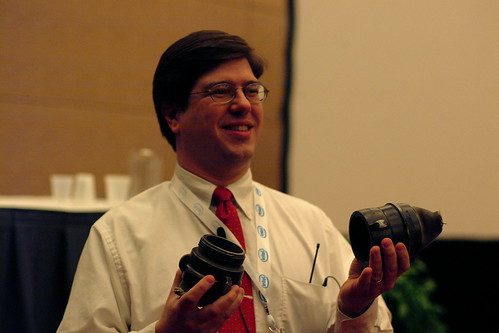 David Wheeler by swhisher
Before talking about why FAR, the Federal Acquisition Regulation, demands agencies to look at open source software when procuring software, I wish to report Gen. Charles Croom priority list for how DISA – the Defense Information Systems Agency – will acquire technologies and capabilities in the future. Defined by the acronym “ABC”, as explained below:
The “A†on that list stands for adopt. The general maintains that his agency will do what it can to take advantage of past investments by adopting both what is in the marketplace and what is in the U.S. Defense Department inventory. This approach is at the heart of providing network connectivity to the warfighter.
The “B†is for buy. If the agency cannot adopt something already on the shelf, then it will go to the marketplace and buy what is needed. While this lacks the economic savings of using what is at hand, it nonetheless takes advantage of the efficiency in commercial developments.
If neither A nor B can help DISA carry out its mission, then the agency will employ its “Câ€â€”create. Only if all other avenues fail to produce the needed goods or services will the agency generate its own customized solution.
In terms of the “A,†DOD is a large-scale adopter of Open Source as results from what observed Brigadier General Nick Justice, the Deputy Program Officer for the Army’s Program Executive Office, Command, Control and Communications Tactical:
Open source software is part of the integrated network fabric which connects and enables our command and control system to work effectively, as people’s lives depend on it. When we rolled into Baghdad, we did it using open source.
With respect to the “B,†Chuck Reichers, the Principal Deputy Assistant Secretary of the Air Force for Acquisition and Management, said:
We want to pay for unique intellectual property when it’s best of breed, but not succumb to code and vendor-specific lock-in situations. Acquisition of proprietary solutions needs to be a conscience choice, not an assumption.
Last but not least the “C,†with the living example of the Navy’s SHARE (Software, Hardware Asset Reuse Enterprise) repository. James Shannon, program manager for future combat systems open architecture, observed:
But the fact that today we are putting systems that were solely owned or thought to be solely owned by other companies and the fact we have shared them with other companies, I will tell you OA (open architecture) has arrived. We are definitely working to change our Navy business model and we are seeing industry change their business models as a result.
I am among them thinking that Open Source software shouldn’t be mandatory, but at the same extent I firmly believe that Open Source has to have an official seat at every Public Administration table.
Getting back to the FAR issue, considering that the FAR requires government agencies to conduct market research to determine if commercial items or non-developmental items are available, Wheeler wrote that:
An agency that fails to consider OSS options is in direct violation of the FAR, because it would be failing to consider commercial items.
Another reason that most extant OSS is commercial is because U.S. law says so. U.S. Code Title 17, section 101 defines “financial gain†as including “receipt, or expectation of receipt, of anything of value, including the receipt of other copyrighted works.†Most OSS projects are specifically established to encourage others to contribute improvements (which are copyrighted works), a form of financial gain and thus commercial.
I keep citing David’s work because it is really important that people get acquainted with the idea that “Commercial is not the opposite of Free-Libre / Open Source Software“, hence the name of my blog: Commercial Open Source.
The Software Tech News is published quarterly by the Data & Analysis Center for Software (DACS). The DACS is a DoD sponsored Information Analysis Center (IAC), administratively managed by the Defense Technical Information Center (DTIC). The DACS is technically managed by Air Force Research Laboratory, Rome, NY and operated by ITT, Advanced Engineering and Sciences Division.
Technorati Tags: Open Source Government, Wheeler, SoftwareTech news, Commercial Open Source


 A Substantial hole, by Rich.w
 Roberto Galoppini,
  Chris, and
 Game (almost) Over by


 Amanda Lorenzani
 Cisco and its too big but favorite chew-rope by

 be the ultimate resource to replace programmers? What about other languages and environments?
 Open it’s a shop by
  Good will by
Savio Rodrigues 11:31 pm on July 14, 2007 Permalink
Hey Roberto, I can totally understand your point of view.
I’d suggest that any license that attempts to close the SaaS Loophole is going to have an uphill battle. There’s too much code under GPLv2 (and maybe GPLv3 in the future) in use at large SaaS vendors and they’re not going to stand by while the loophole closes. *Or*, if they don’t get in the way of such a license, then these vendors will want the option of paying for the privilege of keeping their modifications private. Sun allows customers to do so with their openJDK project which is under GPLv2. This seems to be the only alternative that large SaaS vendors will accept…at least in my view.
I ask again, why do OSS proponents love SaaS? 😉
Roberto Galoppini 4:55 pm on July 15, 2007 Permalink
Ciao Savio,
my point of view comes from my past experience with the FSF community. I have been spending years as FSFE’s friend, and I firmly believe that GPLv3 in 2002 had much more chances to get closer to the Affero. Don’t get me wrong, I think that Richard is a GREAT man, but he did a big mistake, indeed.
Enterprises, or many of them, do love GPLv2 and now GPLv3. Even some OSS proponents as you pointed it out: OS business models based on SaaS make a lot of sense, as far as we can see. Right?! 😉
Chris 10:13 pm on February 2, 2012 Permalink
“A number of people is happy with the GPLv3, but I am not.”
Should read
“A number of people ARE happy with the GPLv3, but I am not.”
Grammar mistakes anywhere in an article destroy confidence in the rest of it.
Roberto Galoppini 7:07 pm on February 5, 2012 Permalink
Thanks for the note, I updated the article.