Recent Updates Page 99 Toggle Comment Threads | Keyboard Shortcuts

  • Roberto Galoppini 9:37 pm on July 4, 2007 Permalink | Reply  

    Open Source Links: 04-07-2007 

    Survey: Windows loses ground with developers – developers targeting Windows for their applications declined 12 percent from a year ago, from 74 percent to just 64.8 percent. The targeting of Linux by developers increased by 34 percent to 11.8 percent. It had been 8.8 a year ago, according to the survey. Linux targeting is expected to reach 16 percent over the next year.

    Open source investment up 33% in Q2 – Matthew Aslett keeps us updated: The biggest deal of the quarter was done by real-time Linux specialist Concurrent ($14m), open source ESB vendor MuleSource raised $12.5m.
    Rocard se recupera de una embolia cerebral en IndiaMichel Rocard has suffered an embolism in the brain during its trip to India, best wishes for fast recovery!

    What’s the Matter With Standards in China? – Jeff Kaplan reports that an official from a Chinese standards organization maintained that a standard is not “open” if it has any IPR in its specification. In his opinion China’s influence over the direction and content of the standards debate will surely increase, he might be right.

    Microsoft wins Massachusetts file format reprieve – Microsoft’s efforts paid,  Massachusetts included Open XML in a new draft of the state’s technical reference model. I keep thinking that whoever wins the file format war, users are going to loose.

    Six questions to national standardisation bodiesGeorg Greeve, FSFE President, is working hard on (office) open standards. I suggest him to explain the six questions.
    Guide to Open Data Licensing – Rufus Pollock wrote a Guide to Open Data Licensing, a guide to licensing data aimed particularly at those who want to make their data open.

     
  • Roberto Galoppini 12:07 am on July 4, 2007 Permalink | Reply  

    Open Source Marketplace: SourceForge Advisory Board welcomes me! 

    Recently Ross Turk, SourceForge Community Manager, visited me in Rome to find out more about how SourceForge.net could better serve Italian open source communities, developers and users, and we talked a lot about SF Marketplace.Hence, I received the following invite:

    Hey Roberto!

    We’re looking for a select group to advise us on the SourceForge.net Marketplace. Because you are a reputable, knowledgeable member of the open source community and we trust and value your opinion, we’d be honored to have your guidance in the first crucial phase of this initiative. Therefore, we would like to invite you to join the SourceForge.net Advisory Board.

    Exclusive invitationThe road less traveled by Dolinski

    I am really honored to join the SourceForge.net Advisory Board, and I am pretty excited to participate the SF marketplace start-up process. As far as I understand the board will continue to meet regularly on line, in order to be updated and also to give feedbacks.

    Once again, we’ve hand-picked you because we think you can give us invaluable guidance on an initiative that we believe has the potential to push open source further into the mainstream. We are dedicated to making this the best it can be for the benefit of anyone interested in buying or selling open source services.

    Ross, early adopters will be CIOs able to try new approaches, may be taking the road less traveled, and I will do my best to help you to reach them!

    Technorati Tags: SourceForge, RossTurk, RobertoGaloppini

     
  • Roberto Galoppini 11:31 pm on July 2, 2007 Permalink | Reply  

    Open Source Business Models: Xen’s approach 

    Simon Crosby, Xen Source CTO, wrote a post entitled “New open source business models based on Xen“, published by SearchServerVirtualization.com, by , talking about Xen business model.

    Xen has pioneered a new model of open source business – one which uses open source as a reference standard implementation of a component of the offering, but which stops short of a whole product. This encourages multiple vendors to contribute, because adopting that model allows them to add value to the final product and be compensated for it.

    While the Xen business model is not really new, think about the linux-embedded case, sharing standards or participating to sequential innovation sounds succulent, but is not for everyone.

    Sharing the cost of production of a (pure) public good makes sense only if – as seen with the above mentioned linux-embedded vertical market – only a percentage of code is revealed. As a matter of fact part of it is kept private, and represents an opportunity to price the added value.

    He put it really clear saying that:

    The value-added components that vendors must add to the “engine” in order to deliver a complete “car” to their customers allows them to differentiate their products, and gives customers choice. By contrast, had it been the Xen project’s goal to deliver a complete open source “car” there would be no value proposition for the different vendors seeking to add virtualization to their products, and it would put Xen in conflict with the Linux OSVs — some of the most important contributors to the project.

    It is still the split OSS/commercial products business model, a model that has the intrinsic downside that the FLOSS product must be valuable to be attractive for the users, but must also be not complete enough to prevent competition with the commercial one.

    Note that the reduction of the attractiveness of commercial versions occur only if thid parties release new packages containing the missing functionality, but it is quite unlikely. It would require a deep knowledge of proprietary products and/or specific Linux distros, and may be some IP disclosure.

    Technorati Tags: Open Source, business model, Xen, SimonCrosby

     
  • Roberto Galoppini 8:01 pm on July 2, 2007 Permalink | Reply  

    Open Source Customers: about OSS role in the Enterprise 

    Forrester published a study entitled “Open Source Software’s Expanding Role in the Enterprise“, reporting answers from 486 Open Source decision makers, based in North America and Europe.

    Savio Rodrigues commenting a Matt Asay interview that I also mentioned, wrote about the Forrester report, and reading it I found some food for thoughts besides the highlights of Savio and Matt posts.

    The #1 attribute of open source that enterprise decision makers care most about: “Supporting open standards”.

    Open source doesn’t guarantee open standards. But as the data indicates, the key attribute of OSS in the eyes of enterprise decision makers is open standards. OSS vendor/buyer/user beware.

    You got a point Savio – and as you probably know Bob Sutor recently suggested to divorce open source from open standards – but Open Source firms backing open source projects are used to share standards. Choosing to cooperate in technological endeavours – i.e. participating a technological club – happens only if the benefits of cooperation outweigh the costs, and it is not rare to see OS firms doing it.

    About the second most important OSS attribute reported by Forrester,  “using without restrictions”, you kept it for a second post, and while waiting I wish to stress that it is a pretty typical open source attributes, indeed.

    Matt, who previously wrote a longer post about the report, said:

    Surprisingly, the biggest inhibitor to open source adoption seems to continue to be a lack of support/services.

    I am not that surprised, and (unfortunately) has little importance that:

    [..] any moderately used open source project now has at least one credible source of support for it  [..]

    As Matt himself reported later, companies like Unisys or Accenture are bringing open source into the enterprise, and even if small firms sometimes do even a superior work, they don’t have the necessary credibility.

    The problem is that Large to Medium customers look for enterprise level vendors, but even those vendors can not offer personalization or integration for hundreds of OSS.
    A Pyramidal approach, where large System Integrators would act as “mediators” towards small specialized firms, is missing, and it is not trivial to set up for a large number of OS projects.

    Last but not least I wish to report an interesting Forrester’s statement:

    Forrester found a few differences between North America and Europe in how firms want service providers involved in the selection, certification, and operation of their open source stacks. Europeans were more likely to want service suppliers to provide assistance in selecting open source software and to offer operations assistance, but the North American group was more interested in vendor certification of an integrated stack of open source software.

    Why that?

    Technorati Tags: Open Source market, Forrester, SavioRodrigues, MattAsay

     
  • Roberto Galoppini 6:58 pm on July 1, 2007 Permalink | Reply  

    Open Source Links: 01-07-2007 

    The startup guide to investors – Some information about dealing with investors, useful for IT startups.

    FSF releases the GNU General Public License, version 3 – The Free Software Foundation released version 3 of the GNU General Public License (GNU GPL).

    Open Source Gaining in SOA, ESB and EAI – Apparently there is solid momentum for open source solutions at the messaging and integration layer now.

    MySQL Grows Up – Noel Le says that the more FOSS technologies and the FOSS community mature, the more FOSS firms will adopt formal capital and organizational structures. I agree.

    OpenOffice.org API Tutorial – A pointer to a detailed tutorial about the OpenOffice.org API.

    The Taxonomy of Conferences – James Mc Govern asks what if conference attendees could also provide ratings on all the conferences they have attended along with reviews, a sort of the Amazon book review mechanism.

     
  • Roberto Galoppini 8:02 pm on June 30, 2007 Permalink | Reply  

    Red Hat RHX: Savio Rodriguez opinion 

    Savio Rodriguez wrote an interesting post on RHX, here a small excerpt:

    The open source community really doesn’t need another arena for projects to live and be downloaded from. There are plenty of players in this space (Sourceforge, Apache, Google, Codehaus, etc.). RHX isn’t intended to drive 1M downloads a day, or hundreds of project ratings. These are functions that developers generally do. Enterprise buyers and decision makers are less likely (not unlikely) to play this role.

    Read the full post.

     
  • Roberto Galoppini 7:12 pm on June 29, 2007 Permalink | Reply  

    Open Source Links: 29-06-2007 

    Open source BI – Is Open Source BI seriously threatening to the traditional markets of companies such as Business Objects and Cognos?

    How Microsoft helps open source – Dana interviews Matt Asay, recently became his colleague. Is Microsoft really helping Alfresco to expand its market with SharePoint?

    OpenBSD founder: Intel leaves open-source out in the cold – Theo de Raadt , OpenBSD founder, accused Intel of understating the impact of bugs affecting Intel Core 2 processors.

    Open Source Apps: Now With Smaller Teams – It seems like some open source projects are doing more with less.

     
  • Roberto Galoppini 4:25 pm on June 28, 2007 Permalink | Reply  

    Open Source Links: 28-06-2007 

    The Open Source CEO: Gianugo Rabellino, Sourcesense (Part 16) – Matt Asay keeps interviewing Open Source CEOs, a bit like my blog category “my meetings” (great minds do think alike!;-). This time is Gianugo’s turn, and he beat me to it!

    Solving the Open Source Conundrum – Glyn Moody talking of the problem with the term “open source” brings IBM software patents into the debate, not sure I like the approach.

    GPLv3 due on Friday 29th – After a year and a half, GPLv3 is finally due this Friday, June 29th.

    W3C Public Conference – Public Not Invited – A meeting about “Toward More Transparent Government” was suuposed to be public, when CNet attempted to cover it, the meaning of “Public” was reversed to mean “Closed to public”.

    ODF is not open source, is open standard – Bob Sutor suggests to divorce open source from open standards, and I insist saying that European IT companies should pay more attention to the swpat debate.

    Something strange about WordPress – James Governor on WordPress, also my platform of choice. I take the chance to send him a meme about Open Source Franchising. 😉

     
  • Roberto Galoppini 2:35 pm on June 27, 2007 Permalink | Reply  

    Open Source Advocacy: from hecklers to lobbyists (part II) 

    Few months ago I wrote about the need of open source lobbyists, just after Dana Blankenhorn post, and I eventually ended reporting Florian Mueller and Simon Phipps opinions around software patents war.

    Florian Mueller, “No lobbyists as such” author and founder of the NoSoftwarePatents.com campaign, has recently announced to take his blog offline in about a month, because he retired from the patent policy debate, and I took the chance to ask Florian two more questions.

    Talking about the role of interoperability, you wrote me that also Google played a role, so which is their position, in your opinion?

    As for Google, I’m quite sure there are lots of people inside Google (well, even inside Microsoft) who are anti-swpat personally but the company position isn’t really clear. The only thing they really cared about in the final days before the EP’s 2nd reading vote 2 years ago was interoperability, just so they can continue to analyze PDF documents without infringing Adobe’s related patents etc.

    Are you about to leave for good the patent policy debate? Why?

    I still care about the software patent issue and a competitive software market, and I believe that my long-standing concerns over their impact have been validated by Microsoft’s Novell-type deals and its announcement to collect royalties from FOSS users. But after my recent and successful project to defend certain strategic interests of Real Madrid in the context of the EU’s ongoing sports policy initiative, I’m at least ten times more likely to take on another football-related assignment than to get involved with patent policy again.

    I just don’t see that companies with an interest in fighting software patents would make the level of resources available that I would consider to be a reasonable basis. In other fields that’s a lot less of a problem, if any. That’s just a market reality.

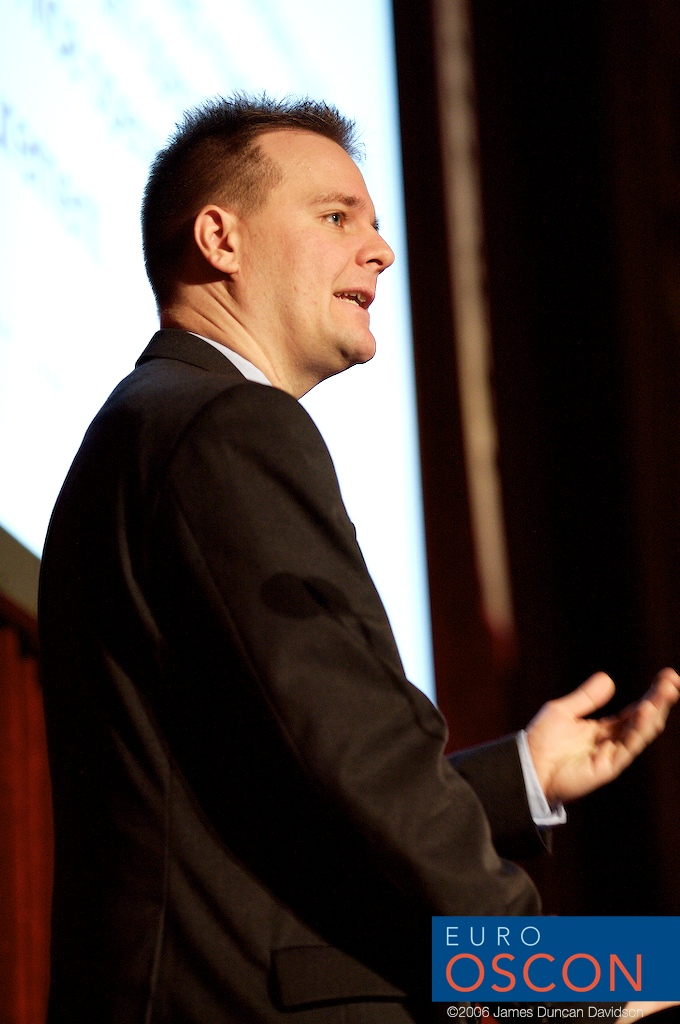
    Florian Mueller
    Florian Mueller by duncandavidson

    In Europe we are still facing very talented lobbyists working hard on this controversial political issue, and despite patentability of computer-implemented inventions is not yet legal in Europe, there is still a lot of work to be done.

    Interoperability matters, but software patents do matter even more: the file format war is not the ICT market panacea. I invite medium to large IT European companies to think about it, and invest money to lobby. Now.

    Technorati Tags: google, software patent, lobbyists, mueller

     
  • Roberto Galoppini 12:19 pm on June 26, 2007 Permalink | Reply  

    Barcamp: Vlogcamp, a barcamp on Video-blogging 

    The first Italian Barcamp about video-blogging and Web TV went live over the Internet in many different forms, last Saturday from Taxi Channel studios, here in Rome.

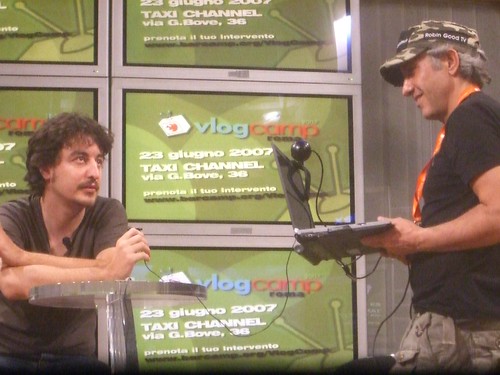
    vlog camp Vlog camp, Robin Good & Tommaso Tessarolo Smeerch

    Despite the hot day, there were quiet a few people, and I happened to know Bruno Pellegrini. founder of Nessuno.TV a portal for Italian videobloggers, and also TheBlogTV, probably the first TV station broadcasting user-generated content. Bruno wrote also a book, entitled “Io? Come diventare videoblogger e non morire da spettatore” (eng: Me? How to become a videoblogger and do not die spectator), given as a present to all participants.

    Tommaso Tessarolo, author of another book entitled “NetTv“, was also present, and he presented an interesting backstage video.

    Robin Good went live all the time on his robingood.tv, I happened to help him recording his speech about how to become a video-blogger, and I interviewed Amanda Lorenzani and Leo Sorge talking about Italian startups.
    Robin Good reported the whole event through two different posts Part 1 and Part 2, if you speak Italian or you want to, have a look!

    Technorati Tags: vog camp, barcamp, theblogtv

     
    • Savio Rodrigues 8:52 pm on June 26, 2007 Permalink

      Hey Roberto, thanks for keeping us in the loop. Looks like a great time even if I can’t understand Italian 🙂

c
Compose new post
j
Next post/Next comment
k
Previous post/Previous comment
r
Reply
e
Edit
o
Show/Hide comments
t
Go to top
l
Go to login
h
Show/Hide help
shift + esc
Cancel