Recent Updates Page 110 Toggle Comment Threads | Keyboard Shortcuts

  • Roberto Galoppini 9:10 pm on March 21, 2007 Permalink | Reply  

    Open Source CMS: the Centre for Inclusive Technology evaluated accessibility 

    The Centre for Inclusive Technology looked at some Open Source CMS in order to assess which would be most suitable from an accessibility point of view. Read the article edited by Josuha O’Connor, Senior Accessibility Consultant CFIT, screen test were executed by Paul Traynor, Expert Screen Reader Evaluation.

    access

    Methodology

    In order to give these tests a real world flavour and to ensure they were ecologically valid, we consciously did not use any particular testing method or script in order to access how intuitive these systems are out of the box.

    For the tests we looked at:

    • Jadu
      .
    • Mambo
      .
    • Joomla
      .
    • Quick and Easy
      .
    • Expression Engine
      .
    • Plone
      .
    • Drupal
      .
    • Textpattern
      .
    • Xoops
      .
    • Typo3

    Results

    Our feedback derives from user testing and observation of a screen reader user performing the following basic tasks, as well as the same tasks being performed by a user with no Assistive Technology/Special User Agent requirements and with an average computer skill level.

    The tasks included:

    • Uploading content and, where possible, editing and formatting content (using a WYSIWYG editor).
      .
    • Creating new pages (Category/Section headings and sub categories/headings).
      .
    • Basic administration of user groups and permissions.
      .

    Some excerpts from the results:

    Joomla

    Visually, the graphic style of the Mambo interface was pleasant to work with and the style of the Windows operating systems graphics would no doubt be appealing to many users and would not be too much of a departure from what they are used to, so this could be an advantage.[..]

    Some problems encountered were:

    1. Some links reading On Mouse Over could not be activated by pressing the Enter key.
      .
    2. Various items had checkboxes, etc. that weren’t very intuitive. The labels didn’t convey their purpose effectively to the screen reader user.
      .
    3. Radio buttons read well but their labelling could be improved. They often were not understandable as to what purpose they served.

    If these problems could be addressed, we would recommend Joomla.

    Plone

    From a usability perspective our first impression of Plone was that it is not that intuitive. This is primarily down to the labels and page types but this could be improved, as Plone is highly customisable. It is very feature rich out of the box and this may be why it feels rather unwieldy and a little intimidating.[..]

    The negative points are:

    1. Overall lack of consistency between what elements are visible when in forms mode/virtual PC mode.
      .
    2. The naming conventions for items used in the interface are a little unintuitive. Use of terms like Smart Folder wasn’t great, and we had no idea what a Smart Folder does. However, reading the manual would no doubt shed some light on this, which as previously stated, we have not done for this test in order to assess the CMS‘s level of instant usability.

    Overall, Plone was a good CMS and highly customisable and extendable. We would recommend it.

    Drupal

    In terms of the interface out of the box, Drupal takes the opposite approach to Plone. The interface is simple uncluttered and clean.[..] It could however be improved. For example the labelling of checkboxes in the blog administration page is not very good. There are checkboxes that allow the administrator to set permissions for anonymous and authenticated users that are also not labelled very well. This makes it difficult for a screen reader user to administer the site well as they cannot associate each checkbox with its relevant command.

    However, these are our first impressions and we feel that Drupal is one of the best that we have come across and would recommend it with some customisation.

    Read the full article.

    Technorati Tags: open source, CMS, Plone, Drupal

     
  • Roberto Galoppini 5:58 pm on March 21, 2007 Permalink | Reply  

    Embedded Linux: Ocean Blue chooses commercial Linux for Set Top Boxes 

    Ocean Blue, a UK software house developing software solutions for the digital home, Digital TV, mobile TV and Digital Video Broadcasting markets, has chosen Linux for advanced Set Top Boxes.

    Bristol, England – 20 March 2007 – Ocean Blue Software, the specialist digital TV software developer, has released a Linux version of its Sunrise, Voyager, and SurfSoft software products, with ports to the leading hardware platforms complete or well under way. The company reports that Linux is emerging as the preferred platform for developers of set-top boxes, particularly at the high end, such as Digital Video Recorders (DVRs) and IPTV.

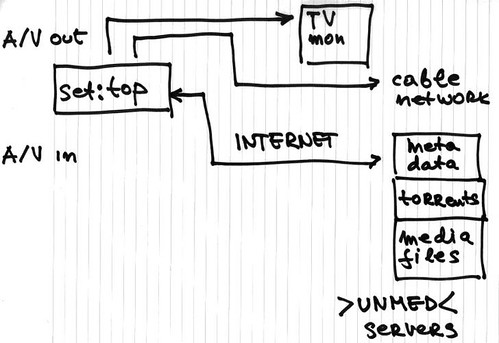
    set top box chartset Top box Diagram by drazen

    Ken Helps, Managing Director of Ocean Blue Software, commented:

    The major chipset manufacturers are introducing new Linux platforms almost monthly, IT vendors that wish to produce products for the Digital Home and are used to working with Linux in the past, now have the option of using Linux based DVB and MHEG-5 Digital TV software products. The Linux operating system features in many of the new raft of IPTV Set Top Boxes, being powerful enough to support advanced functions but not requiring a license fee. All the industry reports indicate strong growth in this area and we are developing our software to support most platforms.

    Today I asked Ken if they are using non-commercial Linux distros:

    Chipset vendors such as NXP ( formerly Philips semi-conductors) and Toshiba Electronics usually adopt or develop a mature, robust version of Linux for the embedded set top box market sector. The Set top box (STB) market is different from the pc market as these digital TV set top boxes are generally closed boxes, with no floppy or CDROM drives, no USB connection and therefore no way to update the software inside the set top box. Hence the Linux and Digital TV middleware software inside these TV receiver devices has to be robust, tested to Digital TV software industry standards, fault tolerant if possible , compact and mature.

    As far as I understand players like Montavista, providing commercial-grade Linux OS for embedded systems, are welcome in some niche markets, and Television and Home Entertainment is definitely one of them.

    Technorati Tags: Commercial Open Source, Embedded Linux, Montavista, Ocean Blue

     
  • Roberto Galoppini 2:43 pm on March 20, 2007 Permalink | Reply  

    Embedded Linux: Commercial Linux vs non-commercial 

    Venture Development Corporation, a technology market research and strategy firm, has recently published “Linux in the embedded system market“, a study revealing that embedded hardware makers prefer non-commercial Linux solutions over commercial ones.

    The author, Stephen Balacco, stated:

    While some OEMs have chosen to use a commercial Linux solution, more are using and/or expect to use a publicly available Linux solution in future project development. It is this trend that will continue to put pressure on commercial Linux suppliers to provide value above and beyond the growing sophistication of publicly available Linux solutions.

    embedded market shareVDC survey’s graphs (current&expected users), reported by Linuxdevices.com

    Survey respondents, chosen from embedded systems developers, were 428. As you can see 12% of them use non-commercial Linux distro, while only 3 percent use a commercial Linux OS. VDC asked also about future plans and discovered that 20% of interviewed developers plan to use a non-commercial Linux distro and only 5% a commercial one.

    No surprise that non-commercial is the hardware makers’ favourite choice, allowing them to avoid the burden of licensing and to make savings maintaining internally their platforms.

    Balacco talking about the preference for non-commercial distros said:

    [the preference] will continue to put pressure on commercial Linux suppliers to provide value above and beyond the growing sophistication of publicly available Linux solutions.

    I totally agree, let’s see how will eventually react commercial Linux suppliers to this challenge..

    Technorati Tags: Commercial Open Source, Embedded Linux, VDC

     
  • Roberto Galoppini 12:55 pm on March 19, 2007 Permalink | Reply  

    Business development: is Red Hat Exchange a real change? 

    Red Hat keeps working hard to create the first Open Source powerhouse: after JBoss purchasing Red Hat last week announced its Red Hat Exchange program, somehow redefining its long-term strategy.

    red hat 5RHEL gdm login page by kOoLiNuS

    Some excerpts from the Red Hat press release:

    Red Hat Partner FederationRed Hat customers are demanding the benefits of open source beyond the infrastructure level, but have been impeded by the complexity of deploying open source business solutions. In response, Red Hat has worked with customers and partners to develop Red Hat Exchange (RHX), which provides pre-integrated business application software stacks including infrastructure software from Red Hat and business application software from Red Hat partners.[..] Through RHX, Red Hat seeks to reduce the complexity of deploying business applications and support the development of an active ecosystem of commercial open source business application partners. RHX will be available later this year.

    Probably JBoss acquisition can’t be considered a step toward building a (large) multi-unit enterprise, or at least this is not the only strategy Red Hat put in place at this stage.

    Customers are demanding services beyond the infrastructure level, but offering them technical integration, broad support, legal indemnification, in one one-stop shop solution could be tough. Red Hat is getting its chance to become the leader of the pack through RHX, some firms already joined and welcomed the initiative.

    I totally agree that it is an important signal on the importance of the open source enterprise stack, let’s see at which extent Red Hat will be able to keep federating partners.RHX may help open source vertical applications uptake, as asserted by Paul Doscher, Chief Executive of JasperSoft:

    Rhx is the Good Housekeeping Seal of Approval for applications, I think it will knock down the last barrier delaying companies from adopting open-source applications.

    Neither Gartner nor IDC are betting on Open Source applications’ rise yet, but Red Hat has good chance to run an important role in the open source ecosystem.

    RHX approach is definitely less risky than keep acquiring, especially considering that getting advantage of increasing returns with non-rivarly goods is not easy.

    Technorati Tags: Commercial Open Source, Red Hat, RHX, non rivarly, increasing returns

     
  • Roberto Galoppini 10:57 pm on March 18, 2007 Permalink | Reply  

    Open Source Prize: Google Summer of Code deadline is approaching 

    If you are a student interested in participating to Google Summer of Code 2007 – no longer accepting applications from open source organizations – you have to submit your applications by the March 24th deadline. Thomas Cort succesfully participated last year and he is sharing through his blog some suggestion for your applications.

    summer of codeSummer of Code Brazilian poster by omaciel

    explain what the project is and what will be accomplished, explain why you are perfect for the project, convince them that you won’t drop out half way through, show some previous Free software or school work you’ve done so that they know you aren’t full of crap, popular projects ideas may get many good applications so choose your desired project carefully, become familiar with the organization that you wish to participate in, and know what you are getting yourself into. The best way to do the last two is to actually read through the project’s website and browse some of the code.

    By the way no student has applied to the province of Rome contest yet. If you live here please take your chance!

    Technorati Tags: Google Summer of Code, Open Source, Rome

     
  • Roberto Galoppini 6:50 pm on March 17, 2007 Permalink | Reply  

    European Open Source Projects: pay once should be enough 

    European Community is now financing 6 different projects within the 6th Framework program related to FLOSS metrics and quality. As a matter of fact CALIBRE(mentioned) EDOS (mentioned), FLOSSMetrics (mentioned few times), FLOSSWorld, QualiPSo, QUALOS and SQO-OSS are somehow overlapping:

    waste

    Complete waste of energy by rooreynolds

    CALIBRE aims to coordinate te study of the characteristics of open source software projets, products and processes, distributed development, and agile methods.

    EDOS – The project aims to study and solve problems associated with the production, management and distribution of open source software packages.

    FLOSSWorld – It is expected that FLOSSWorld will enhance Europe’s leading role in research in the area of FLOSS and strongly embed Europe in a global network of researchers and policy makers, and the business, higher education and developer communities. FLOSSWorld will enhance the level of global awareness related to FLOSS development and industry, human capacity building, standards and interoperability and e-government issues in the geographical regions covered by the consortium.
    QUALOSS objectives:

    • Build the QUALOSS methode, an objective method to assess the robusteness and evolvability of open source software
      .
    • Develop the QUALOSS platform, a tool to automate most activities when applying the QUALOSS methos
      .
    • Validate the QUALOSS empirically on at least 50 open source projects

    SQO-OSS – The project is developing a comprehensive suite of software quality assessment tools. These tools will enable the objective analysis and benchmarking of Open Source software. SQO-OSS aims to assist European software developers in improving the quality of their code, and to remove one of the key barriers to entry for Open Source software by providing scientific proof of its quality.

    Many of these projects are collecting data from public open source repositories, some are working with thousands projects while others are focused on a tiny fraction of. Though all of them are supposed to collaborate with other projects investigating the same area, apparently they have no specific funds dedicated to coordination of tasks.

    On the other hand collection, aggregation and correlation of data fetched by public repository is getting everyday more important both for Public Administrations and firms. The analysis is more and more complex and it is really a waste of resources to let projects overlap.

    By the way looking for posts about European financed projects I happened to read the following posts. The first is from the Open Source Weblog (Matthew Aslett):

    While it is not altogether clear what QualiPSo will deliver that the various existing open source promotion activities and consortia are not, it will be interesting to see the results of the CMM-related project for assessing software quality.

    Other areas, such as the plan to “define a coherent family of open source software licenses” would appear to step on the toes of the OSI just a little bit.

    The second, still talking about Qualipso, is from Glyn Moody:

    Developing a new Capability Maturity Model-like approach to assessing the quality of OSS. This model will be discussed with CMM’s originators, the Software Engineering Institute (SEI), with a view to formalising it as an official extension of CMMI.

    What? Maturity? What’s this got to do with getting people to use the ruddy stuff?
    QualiPSo is launched in synergy with Europe’s technology initiatives such as NESSI and Artemis, and will leverage Europe’s existing OSS initiatives such as EDOS, FLOSSWorld (http://flossworld.org/), tOSSad (http://www.tossad.org/) and others. The project will also leverage large OSS communities such as OW2 and Morfeo.

    Oh, now I see: all this is just an excuse for more acronym madness. So it’s basically just a waste of money, and a missed opportunity to do something practical.

    But wait:

    QualiPSo is the ever largest Open Source initiative funded by the EC.

    OK, make that the biggest waste of money, and biggest missed opportunity yet.

    I’m definitely not a fan of the Public funded “business” model, but as Italian and European citizen I can’t be happy I am not alone. I really want to make a wish now: no more random public funded projects, please.

    Technorati Tags: commercial open source, research, public funded, qualipso, flossmetrics, edos

     
    • Flavia 6:59 pm on March 17, 2007 Permalink

      Your post it is a kind of “mental floss”, a tentative to bring some light in the matter.

    • gaidin 10:41 am on March 22, 2007 Permalink

      I have had a presentation of all the projects you mentionned at the beginning, and except EDOS, I’ve had the same feeling as yours : they are overlapping, and aren’t going to produce anything beside reports.
      Qualipso seems a little different, though.
      I must say, the weight of the industrial partners in those projects makes the topic of interests very far from what we consider “useful”, as “we” are more interested in improving the code base rather than making money, nor are we fighting a stupid US vs EC economic war.
      Also, most Free Software Communities, that are not political conglomerates, have no voice to be heard. That discards in a very effective way any useful idea.

      I think the only good funding for actual useful Free Software comes from Google’s Summer of code.

    • Roberto Galoppini 11:29 am on March 22, 2007 Permalink

      I see your point Gaidin, and that is what I am concerned about: how is it possible that EC keeps accepting overlapping projects?
      My suspect, and I am not alone here, is that EC is lacking of skilled evaluators, turning in random results, as its best.
      I do know evaluators that recommended me to apply just for this reason. I applied twice but I have never got a single answer.
      But the pie is getting bigger and bigger, and firms are not staying at the window, of course.

      You mentioned firms’ dimension as an issue, and you might be right in this respect. EC recognizing that “Europe is good for SMEs and SMEs are good for Europe” is trying to make public calls for tender more accessible for small companies.

      If a company, or individual, finds that EU laws, and the rules of the single market, are not being properly put into practice or interpreted by public authorities, entrepreneurs can find a solution by contacting the Commission’s online SOLVIT service

      By the way you cited Google Summers’ of code, and I agree is a good example but.. while Google is a big company, they are not begging money from the State, and it makes a huge difference to me..

    • gaidin 4:00 pm on March 22, 2007 Permalink

      About Google, the whole situation of fearing an american centric domination through what google is trying to do with the summer of code or the Library, reminds me of a joke that was circulated by email.

      A kind woman from Human Ressources decided to celebrate christmas at work by giving a special meal to the employees, and a $30 voucher each. Soon, she received a complain from the non-christian employees who requested their respective holiday to be celebrated as well. Next came all the vegetarians, claiming that they were being set aside from the rest of the company because of the meat-happy special meal.
      And finally, the Unions kicked in, claiming that the voucher was utterly unequal, that it should be increased for larger families ; and rather than vouchers, the fund should be better used towards a nursery for everyone instead.

      The story ends with her having a nervous break-down.

    • Roberto Galoppini 4:18 pm on March 22, 2007 Permalink

      Well, I like the story, you admit slightly off-topic indeed, and I believe that Summer of Code is definitely a good thing. We can’t say Google is running an open source business model, though, but it is contributing a lot, and that is definitely a good thing.

  • Roberto Galoppini 8:36 pm on March 16, 2007 Permalink | Reply  

    Open Source ERP: Compiere’s new CEO first post 

    Don Klaiss, who recently joined Compiere as its new CEO, just wrote his very first post “Will Compiere remain an open source product?“, and it starts this way:

    Shortly after joining Compiere as the new CEO, people began asking me about my plans for Compiere and whether we would be evolving from an open source business model to become a proprietary product. The answer is absolutely not!

    Sometimes people make really weird questions..

    supriseKinder Surprise Egg by knowwonnose

    With more than 1.1 million downloads of our software, we have become by far the most popular open source ERP project. I look forward to working with our customers and partners to create an even more active, vibrant community around our technology.

    As I already wrote I’m looking forward to see Compiere fostering its own community through its new partner program, and I really wish Don all the best.

    Technorati Tags: Commercial Open Source, Compiere, ERP

     
  • Roberto Galoppini 9:49 am on March 16, 2007 Permalink | Reply  

    Evaluating Open Source: Walmart’s criteria 

    Reading Open Enterprise Trend I happened to know about Eugene Ciurana, Director of Platform Technology and Enterprise Architect at Walmart.com, and his view on how Open Source empowers what is called “Enterprise Mashups“.

    penguin andpolar bearFrom Eugene Gallery

    ‘Enterprise Mashups’ Leverage Open Source
    OET: Your tone of “enterprise mashups” appears to take into account the “blending” of open Source and commercial apps/tools throughout the whole enterprise framework, and not simply for client apps? Is that true?

    Yes, it’s true. If we define a “mashup” as an aggregation of disparate technologies to achieve a goal, then an “enterprise mashup” is a way of combining legacy, in-house, commercial, and open-source software to create new products and services for the enterprise.

    Clients are only one part of the mashup. Software as a service, and applications that act as services, consumers, or both, can be integrated together to provide more value than any individual component can by itself. On the commercial side, for example, Oracle acquired a number of companies in the last few years and had to get the products from all of them to inter-operate. They market their products mashup today as Oracle Fusion. Oracle’s experience is no different from the challenges and opportunities that enterprise architects face every day.

    A better example would be rhx, Red Hat effort to create a multi-vendor (interoperable) ecosystem.

    Is Open Source Ready for ‘Enterprise Mashups’

    Evaluating projects and products is a similar exercise regardless of whether they are commercial or open-source. The key is to identify risk factors and weigh them against the benefits of using the Open Source.

    Here are a few questions that must be answered:

    • What is the definition of maturity for the product in relation to the company’s SLA?
      .
    • Is the product mature enough? Does it meet all functional requirements and features?
      .
    • Does it have a rich, thriving community around it? Is the community growing? Is it easy to join and participate in that community?
      .
    • Do the licenses for the product and its sub-components conflict with business goals in any way? Is there an alternate license if this is the case?
      .
    • Are there one or more commercial entities providing support, training, custom development, etc. for the project?
      .
    • Is there a commercial or other entity that provides indemnification for the product’s users?
      .
    • Will the company’s engineering participate in contributing to the project? Is there a policy for releasing code back to the open-source community?

    And, for good measure, here is a question to ask yourself from the gut:Assume that the licensing cost for competing commercial and open-source products is zero. Are the open-source product’s features compelling enough to overcome the feature set of the commercial offering in relation to your business goals and SLAs?

    I was recently involved in one of those selection exercises between OpenLaszlo and an industry standard commercial Flash product. My team followed the selection criteria outlined earlier, including “if the cost is zero, would you chose X?”. Having an understanding of all the issues, business goals, licensing, support, etc. eased the decision to go with OpenLaszlo because the risks and benefits were known prior to committing to this product.

    Here in Europe, we have no software patent yet, and I can’t buy his suggestions about indemnification but I found his final question fundamental.

    Technorati Tags: Open Source, mashup, Walmart

     
  • Roberto Galoppini 1:11 pm on March 15, 2007 Permalink | Reply  

    Microsoft-Novell press release 

    moneyGraeme by Zed & 2 Naughts

    HSBC Taps Microsoft-Novell Agreement to Reduce Linux Cost and Complexity

    Global bank selects SUSE Linux Enterprise as its standard Linux distribution, citing interoperability with Windows Active Directory and integrated Windows and Linux platform support.

    REDMOND, Wash., and WALTHAM, Mass.—13 Mar 2007—Microsoft Corp. and Novell Inc. today announced that HSBC, one of the world’s largest banking and financial services organizations, has joined the growing number of global firms taking advantage of the recent collaboration between Microsoft and Novell. Under the agreement, Microsoft will deliver to HSBC certificates for three-year priority support subscriptions to SUSE® Linux Enterprise Server from Novell®, as HSBC moves to standardize its Linux* deployments on one distribution. By reducing the diversity of its Linux environment, HSBC will be able to reduce its total cost of ownership (TCO) for Linux, and improve interoperability with its existing Microsoft® Windows® infrastructure.

    “The Microsoft-Novell agreement is a great catalyst to helping us reduce the complexity of our Linux environment as we standardize our Linux infrastructure with SUSE Linux Enterprise and continue to extend the use of Microsoft Active Directory®,” said Matthew O’Neill, group head of Distributed Systems for HSBC Global IT Operations. “Some will be surprised to learn that our Windows environment has a lower total cost of ownership than our current Linux environment. Our decision to simplify our mixed-source environment with Microsoft and Novell will allow us to reduce the cost and complexity. That’s why we have selected Novell as our preferred Linux partner to support our Linux infrastructure going forward.”

    Headquartered in London, HSBC’s international network includes more than 9,500 offices with 284,000 employees in 76 countries. HSBC has 125 million customers, 25 million of whom are registered for Internet banking. HSBC provides a comprehensive range of financial services including personal financial services; commercial banking; corporate, investment banking and markets; private banking; and other activities.

    Roger Levy, vice president and general manager of Open Platform Solutions for Novell, is joining HSBC’s Open Source Software Committee as a nonvoting advisor. “The ability of HSBC to reduce complexity, simplify support and increase its IT agility is a testament to the mission of Novell’s agreement with Microsoft — to help customers win,” Levy said. “Novell is pleased to become HSBC’s trusted Linux partner, and standardizing Linux on SUSE Linux Enterprise Server will give the company a rock-solid foundation that will seamlessly interact with its Windows environment.”

    “Our customers tell us that they want technology vendors to work better together — that’s what our agreement with Novell is all about,” said Susan Hauser, general manager of strategic partnerships and licensing at Microsoft. “Founded on intellectual property assurance, our interoperability efforts are helping HSBC apply best practices from its Windows infrastructure to lower TCO for its Linux environment.”

    sources: Microsoft, Novell.

    Technorati Tags: Microsoft, Novell, Commercial Open Source

     
  • Roberto Galoppini 10:32 am on March 14, 2007 Permalink | Reply  

    Open Source Business Models: Wall Street analyst 

    Stephen Walli reported on Slashdot a presentation titled “Open Source Business Models: A Wall Street Look at a Wild 2006 and the Prospects for Even More Fun in 2007” by Brent C. Williams, an independent Equity Research Analyst.

    It is really worth reading, read also Brian Berliner’s post about it.

    moneyMoney by grana

    Technorati Tags: Open Source Strategy, Commercial Open Source

     
c
Compose new post
j
Next post/Next comment
k
Previous post/Previous comment
r
Reply
e
Edit
o
Show/Hide comments
t
Go to top
l
Go to login
h
Show/Hide help
shift + esc
Cancel