Roberto Galoppini's
Commercial Open Source Software

Where Free Software meets Business
equally critical of proprietary and open source myths,
advocating software choice beyond
marketing and romanticism

Open Source Projects Outsourcing: North-by-South

Filed under: Commercial OSS, Open Business Models, hackers — by Roberto Galoppini at 1:35 pm on Tuesday, May 6, 2008

North-by-South, is an open source company based in San Francisco and Sao Paulo (Brazil), is getting work from the Bay and organizing teams of open source programmers from Central & South America to do the jobs.

North-by-South, officially started in July 2006 in Sao Paulo at a developers get-together organized for open source veterans, currently have about 30 programmers in its open source developers network and it is planning to expand to 100 developers by January 2009.

Made in Brazil Barbie made in Brazil by wagner_arts

I asked Ryan Bagueros, formerly head of engineering at Tagged, is the North-by-South founder, and co-founder of San Francisco Community Colo, how do they commercialize their services.

We’re in touch with the marketplace through local innovations like Craigslist but mostly we get work through the extensive contacts of our San Francisco team. We have 4 people working in San Francisco on getting jobs, organizing them, etc and we’ve all been working in SF through the first dot-com bubble and now in the “web 2.0″ resurgence. So, we commercialize via word of mouth, web, local conferences, local internet gatherings, etc. It would be much more difficult to get work if we were not located in San Francisco and hadn’t been working here since the mid-90’s.

Brazil and South America as a whole have an absolute advantage over USA in producing open source software, and as a matter of fact what is going on with the free software movement in Latin America is pretty peculiar.

I wish Ryan and his latin American friends happy hacking!

Technorati Tags: , , , ,

OpenOffice.org: OOoCrackz, an Italian Extension to get in the Piracy Market

Filed under: Italians do it, Open Source Recommendations, OpenOffice.org, hackers — by Roberto Galoppini at 9:50 am on Tuesday, April 1, 2008

PLIO, the OpenOffice.org Italian Native-Lang Project association, announces the availability of OOoCrackz, an Extension that allow users to use the free and open source suite in a “crack mode”. The extension aims at answering the needs of 51% of the Italian market, that is in the hands of pirates.

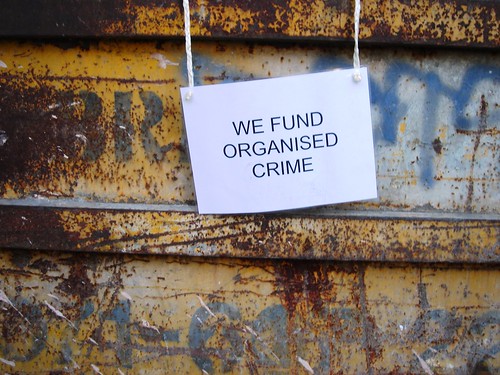
Funding Software PiracyWe fund organized Crime by dontaskme

Davide Dozza, PLIO’s President, explains why the Italian association decided to develop OOoCrackz:

Reading “The Economic Benefits of Lowering PC Software Piracy“, an IDC research sponsored by the Business Software Alliance, we understood that OpenOffice.org license represents an obstacle to the adoption of he suite for about half of the Italian population, actually using mostly pirate software.

OOoCrakcz takes away three out of four freedoms, making illegal the access to the source code, the freedom to modify the code and redistribute it, just as every other proprietary software.

OOoCrackz has been developed by a PLIO’s member, Paolo Mantovani, one of the most known expert on OpenOffice.org macros and extensions expert:

The first release of extension allows only the activation of the “illegal mode”, but we are working on an evolution of the extension that will prevent you from releasing documents under Creative Commons licenses. The risk to manage is that the user could inadvertidly respect the copyright law.

To provide you with a real experience of using a pirate software, OOoCrackz prevents the registration and block all possible updates. The idea behind such choice is to make soon your copy obsolete, eventually exposing the user to security problems as happens with illegal copies.

Italo Vignoli, PLIO’s Marketing and Communication Manager stated:

The PLIO annual assembly announced marketing initiative to improve OpenOffice.org penetration in the Italian market. With this announcement we are targeting the illegal software market, a segment not yet addressed by our offer. This will reflect in our coverage of the market, and therefore we foresee an increase of our market share.

Technorati Tags: , , , , , , , ,

Free Software and Communism

Filed under: My Meetings, Random thoughts, hackers — by Egor Grebnev at 8:31 am on Thursday, March 6, 2008

Today Richard Stallman was giving the last in the series of his three public lectures in Moscow. It was about Free Software and Copyright.

I had a small conversation with him before the talk and asked him why he hadn’t come to Russia since his last visit in 1991. The answer was simple: he didn’t get any invitation. This can be a hint for the people in the countries where Richard has not been yet — if you organize the visit properly and send Richard an invitation, chances are very high that he will come.

InvitationInvitation by sarahkim

He liked today’s Russia more than the one he had seen 15 years ago. Even though his time was very limited, it was sufficient to find out that Russian food (including pancakes and solyanka soup) is good and that people are now paying more interest to Free Software than before.

Richard has a theory for that. In his view, the post-communist countries get warmer to Free Software as they move away from the ideology where freedom is restricted. The younger of us, whose personalities were mostly formed after 1991, are more receptive to the idea of contributing to the benefit of the public. Therefore there are more Free Software users and developers among us than could have been among our parents. There is a similar situation in China.

Richard may be right. We were poorly globalized back in the early 1990’s, and that hindered our acceptance of Free Software (along with thousands of other good and bad things that globalization brings with it). To some extent it may remain a problem even now as we often prefer to do things on our own rather than ask for help, which might be readily provided upon request.

It is not strictly about communism. It is about the science of living in a larger world.

Technorati Tags: , , ,

Italian Open Source developers: Luca Passani

Filed under: Commercial OSS, Italians do it, hackers — by Roberto Galoppini at 11:27 am on Wednesday, October 31, 2007

During the Cocoon GetTogether recently held in Rome, I met Luca Passani, an Italian software engineer experienced in Web and Mobile Internet development, known to the open source community for creating WURFL.

Luca, who spent seven years with Openwave Systems, currently works for AdMob, the world’s largest mobile advertising marketplace. Yesterday I invited Luca - who lives really close by - to have a tea at my house, and I took the chance to pose him some questions about WURFL.

Luca Passani Luca Passani

How it all started?

In 1999 I was involved in a project for Telenor in Norway. They wanted to launch the first European wap portal. The first two devices to hit the market at that stage were: then nokia 7110 – aka the big banana (“bananone”)- and the siemens C35. They had a very different wap browser: fixing usability with one implied screwing it up the other one. That was the beginning of the so-called “device fragmentation” (known also as device diversity).That’s when I started wondering how I could solve the problem. And that’s when phone.com (now openwave) asked me to join them.

Since then, how did you manage to get such large adoption for WURFL?

In hindsight it wasn’t that difficult, because there was a big gap to be filled, and nobody to fill it. It was like if the big Architect of the Mobile Industry had forgotten the roof! The huge problem of device fragmentation was stopping the industry from taking off, and nobody was providing a solution. This was the contest in which WURFL was born, and around which companies found home. Small companies in the beginning, those which could not afford to pay big bucks for a commercial-grade solutions. I was already running a 3000-developer strong mailing list at the time (called WMLProgramming) when WURFL was born. The list provided the ideas, the encouragement and the support to make WURFL a reality in a matter of months. More than that, the mailing list also represented an excellent marketing channel directly into the IT departments of mobile companies. WURFL’s strength was the grass root interest and support.
It is obvious that we got a bunch of stuff right. After a few years, also average-sized companies were using WURFL, and after them, even big guys such as Google and Yahoo Mobile had made WURFL part of their regular device information diet.

WURFL started almost by scratching a developer’s personal itch. Luca’s activity was sponsored by Openwave to empower developers and eventually leveraging the emerging mobile market.

So, how important was the community to make it happen?

WURFL “is” the community. Developers, the silent constituency of the mobile web, had been totally neglected. They found the strength to come together and fix their own problems: creating WURFL and keep it in good shape. My role was simply being the catalyst for this reaction. I created the WURFL schema, I put my understanding of the problem domain to the service of the project. To add to that, I created the WURFL website, I managed the mailing-list, I created the Java WURFL API and, last but not least, I created WALL (a tool to multi-serve multiple markups to different devices classes). Albeit Andrea Trasatti has now left the project, his contribution for many years deserves acknowledgment.

Luca is a “benevolent dictator” placing community before code. He shared the project’s leadership with the co-mantainer Andrea Trasatti for few years, taking in great account the importance of contributors. Small contributions, or “micro-contributions” as I would call them from now on, are the key to WURFL success.

What about the competition, is WURFL the only platform?

Not, it isn’t it. Albeit there is virtually no competition in the open source space. The situation is different with commercial entities: Volantis, MobileAware and ArgoGroup are the commercial counterparts in this space. Despite those products are backed by commercial entities and come with a lof of nice features, (not to mention commercial support), WURFL has unique advantages which are the direct consequence of the adoption of an Open Source model. Commercial solution are typically expensive, too expensive for small- and medium-sized companies in the mobile space. The reason for the high price lies in the need for commercial vendors to build a repository of device information. One needs trained staff to run device tests (a time consuming activity), and labs in different continents, devices cost 100 to 500 euros to acquire. It should come as no surprise that such costs are reflected in the cost of the product. With WURFL the situation is different. While WURFL can afford no paid staff to run tests, its community provides the open Device Description Repository with a steady flow of device information from its adopters and supporters. One could present WURFL as a piggy bank in which one puts one euro and gets back one million. No wonder people think this is a great deal.
On top of that, comes the fact that WURFL is totally open and WURFL adopters can hack the hell out of the framework and make it do exactly what they need. Hardly a possibility with commercial solutions.

I agree with Luca, a proprietary solution has to run after the sun to get it updated, but they could still try to imitate Funambol approach replicating the Phone Sniper program. So said, I also worked for telco operators for years, and I believe that the openness is needed when you want to include and extend technologies.

Technorati Tags: , , , , , , , ,

Internet Governance Forum: workshop proposals online for viewing&merging

Filed under: Free resources, Open knowledge, hackers — by Roberto Galoppini at 6:51 pm on Friday, July 6, 2007

The Internet Governance Workshop proposals submitted within the 30 June deadline have now been posted for viewing. Save the following dates:

  • Deadline for submitting proposal (abstracts + initial list of organizers ): 30 June.
    .
  • Completion of co-organizer and panellist arrangements and merge activities: July.
    .
  • Notification of selection - 31 July 2007.

During July proponents of similar workshops will be encouraged to join forces and collaborate where it is feasible. Organizers of workshops are, therefore, expected to work with others who submit proposals on the same theme. A willingness to merge proposals is a requirement.
The Government of Brazil will host in Rio de Janeiro on 12 - 15 November 2007 the second Internet Governance Forum meeting. The IGF website - run by the IGF Secretariat - supports the United Nations Secretary-General in carrying out the mandate from the World Summit on the Information Society with regard to convening a new forum for multi-stakeholder policy dialogue - namely the Internet Governance Forum.

Technorati Tags: ,

Open Source Hackers: about retaining them, the Novell case

Filed under: Commercial OSS, Get these facts, hackers — by Roberto Galoppini at 7:30 pm on Saturday, May 5, 2007

In dicember Jeremy Allison of Samba fame resigned from Novell in protest over the Microsoft-Novell patent agreement, about a month ago Jeremy Irons, one of the lead developers of the Samba Team, also left Novell giving advices to young programmers, and now it is Robert Love turn to leave, as reported by Dave Rosenberg.

Managing human resources by Mark & The Zebra

Robert Love in his blog wrote a post eloquently entitled “epilogue“.

An operose decision, I resigned as Chief Architect of our Linux Desktop endeavor, effective today.

In the house that Ximian built, we dreamt and saw to fruition the world’s finest Linux desktop, Linux’s first desktop commercial success. Seated at the table aside some of the industry’s sharpest hackers, we challenged ourselves not with the goal of building another Linux desktop, but with the aim of engineering a more perfect desktop—Linux or otherwise. Unsatisfied with simply cheaper, we went for broke: better and faster, too. SLED’s éclat is ours.

Leaving is never easy. But here and now the timing is right and so, after three and a half years, here’s to what’s next.

It is great time for Novell, and not only Novell, to understand that free software’s gurus and open source hackers need love too. The employer knowing exactly what is annoying people can respond and retain people longer. Is Novell listening hard enough?

Open Source firms selling software made from scratch within their organizations - what I call Corporate Production Model - don’t need to pay to much attention to retain their employees, no more than any other software company.

On the contrary firms basing their business on commons, need to feed patiently and persistently the hackers they hired. Weak intellectual property assets need a lot of care, appropriating returns is already difficult without extra handicaps.
Whether Microsoft is really hiring Open Source Evangelists or not, Commercial Open Source firms have to pay a lot of attention, hackers are precious to them.

Technorati Tags: , , ,

Open Source Hackers: Brian Behlendorf’s speech at the Digital Freedom expo

Filed under: Commercial OSS, Get these facts, Open knowledge, hackers — by Roberto Galoppini at 2:08 pm on Saturday, April 21, 2007

Brian Behlendorf, Apache founder and now CTO at Collabnet, on Thursday at the Digital Freedom Expo gave a speech entitled “Ten things you may not know about open source“.

open standard campaignOpen Standard campaign by 4_eveR_Young

Some excerpts out of his list:

2. Apache kept the Web flat and free

Apache was launched in 1995, at the time Netscape was the dominant Web browser and there was a fear that if the same company could own the browser market and the server market they would have too much control and could charge companies a tax of sorts for web hosting. Apache’s launch was done with a dual purpose. There was the pragmatic aspect of combining efforts for better development and there was the idealistic aspect of keeping HTTP (Hypertext transfer protocol) as an open standard.

That is really interesting. Enforcing an Open Standards through an open source reference implementation. Someonelse is also suggesting the need for a reference implementation to augment – if not, perhaps, replace – the formal specification of the standard.

4. Open Source helped free the human genome

Before the mapping of the human genome had been completed, a commercial consortium, Celera, was sequencing the genome with the intention of patenting it. This preposterous idea of patenting a discovery rather than an invention began to get many geneticists concerned. In about 2002 a doctoral student, Jim Kent, wrote 10 000 lines of Perl code to make a program that could perform the number crunching of raw data that was necessary in sequencing the genome. This program [Human Genome Project] was then run over 100 Linux servers and the entire genome was successfully sequenced a few months before Celera finished.

While more related to Open Knowledge this story is really interesting, in 2002 Tim O’Reilly described Kent’s work as “the most significant work of open source development in the past year”.

5. Microsoft loves open source

As odd as it sounds, Behlendorf explained that Microsoft has benefitted from open source development and also included software, which although not labeled “open source”, had the source code openly provided. The first use of TCP/IP in Windows was a port of Berkley’s code. He sited the work that Microsoft was doing with open source programs such as MySQL, SugarCRM and JBoss. Codeshare, Channel 9 and other websites were also cited as positive signs that the proprietary giant is openeing further, as Behlendorf put it, “dragged kicking and screaming into the future”.

So I am alone thinking things like that. Ten days ago I happened to see a meeting of developers belonging to a Microsoft’s community and I was quite impressed.

6. Altruism is not the only reason why people contribute to open source software

Many contributors use the software professionally and find that doing things such as fixing bugs and adding features is much easier when collaborating within a group. According to a survey done in 2006, the existing base of FLOSS represents 131 000 real person years of developmental effort. The costs of sharing code are low while the benefits are high.

Many thanks Brian, I am really tired to listen to professors talking about gifts and fun, I am happy that people hacking for real can tell them the truth.

9. Open source can still change the world

Behlendorf strongly believes in the power of open source to make the world a better place, citing many examples. Within government, he believes that open source software can help immensely in counting election votes in a trustworthy way and also with transparency of government’s actions and policy. For countries such as China where there is restricted acces on the internet, open source has already been successful on helping people within these countries get greater access by overcoming the censorship exerted on them. Third world development can benefite greatly through initiatives such as the One Laptop Per Child project which runs on entirely open source software for the dual purpose of making it cheaper to produce and so that it can be modified to suite each country’s specific needs. Fighting digital rights management was another example given.

Technorati Tags: , , ,

Open Source Evangelism: Whurley first TalkBMC post

Filed under: Commercial OSS, Random thoughts, hackers — by Roberto Galoppini at 9:29 pm on Thursday, April 19, 2007

William Hurley, who recently joined BMC as Chief Architect of Open Source Strategy, yesterday wrote his first TalkBMC post, explaining clearly what open source is to him.

cureAn odd cure by Mr Jaded

Nestled between Proprietary and Freedomberg, Opensville is a utopia. Everyone who lives in the adjacent cities spends their free time in Opensville. The parks are beautiful, the shopping is amazing, and the nights are pure Vegas. Sounds like a great place, huh? One problem: no one actually wants to live there. No one wants to pay the taxes or put in the effort it takes to keep the city running. Welcome to Opensville, population zero. [..]

Nagios is one of the most popular monitoring projects in open source, and one of the most abused. There are countless projects, products, and services predicated on the Nagios code base—some symbiotic, others non-contributing parasites. What separates legitimate use from outright exploitation? Where would you draw the line? Should violators be black-listed by the community?

To me, open means that everyone can participate on a level playing field. As a community we have to take the good with the bad, but I cringe when I see a project taking more than its fair share of punishment. How will the community address this problem? Should there be a rating system? A sort of mooch-o-meter to rank companies and projects that use open source? Would that subjective hierarchy help or hurt the community? How would it be regulated?

The community has to answer some of these questions if open source is to continue to flourish. Everyone who leads, participates in, or utilizes an open source project should realize they have a personal interest in protecting it from abuse. Keeping the pirates honest will take effort, but the repercussions of apathy will affect us all in the future. Besides, tales of the pirate hunters are often more exciting than the tales of the pirates themselves.

As Matt Asay William seems to think that the best policing mechanism to answer the question is the community, but auto-referentiality might also be dangerous.

Could the cure be worse than the ill, eventually?

Technorati Tags: , , ,

Barcamp: Opencamp, a barcamp on Open Source and Open Minds

Filed under: Commercial OSS, Italians do it, My Meetings, hackers — by Roberto Galoppini at 9:38 pm on Monday, April 16, 2007

Last saturday Rome guested the Opencamp, an ad-hoc gathering to share and learn in an open environment about Open Source and Open Minds (i.e. Digital Freedom, Trusted Computing, Net Neutrality, Collaborative Web, Creative Commons, Politics and Tecnology, Web and Technology Standards, and more).

opencamp logoOpencamp logo, designed by Stefano Federici Simone Onofri

Opencamp, organized by “LSLUG”, a local Linux User group, is the second BarCamp held in Rome, and was quite different the first. Among attendees - not many to be honest - there were either industry professionals or IT students, with practical work experience on FLOSS (Adriano Gasparri, Matteo Brunati, Nicola Larosa, Andrea Martinez, Alberto Mucignat, Luca Sartoni, Giacomo Tufano and Italo Vignoli just to name a few), along with some stars of the Italian Blogosphere (Stefano Epifani, Alessio Jacona, Nicola Mattina, Antonio Pavolini, Tommaso Tessarolo, Leo Sorge, etc).

I took the chance to give a speech completely different from “Free as in Business: lucrative coopetition“, and instead of being informative on open source business model taxonomies, I chose to share some reflections to open the debate.

Considering that Italian VCs are not open to invest in open source firms because of the “weak” intellectual property asset, I suggested hackers to keep into consideration the following arguments:

Software, Free Software is a digital good, whether SourceForge’s marketplace will work or not, the Web can help to agglomerate geographically dispersed market segments–the proverbial ‘Long Tail’.

Hackers have a chance to become contributors, may be even committers, and eventually open up their shops. They can also simply get hired by software firms or, more likely in my opinion, IT customers willing to get the “open source promise” - be independent - granted.

If you can catch Italian have a look at RobinGood posts (OpenCamp Part 1 and OpenCamp Part 2), a very good example of how online video might be used to deliver live contentusing ustream.tv.

Last but not least, special thanks to SanLorenzo for its free - as in good vine - food!

Technorati Tags: , , , , ,

Second Life: the practical developers’ guide to Second Life Client

Filed under: Free resources, Licenses, Social Networks, hackers — by Roberto Galoppini at 5:48 pm on Wednesday, April 11, 2007

With the new year Linden went (partially) Open Source releasing its Second Life client with a GPLv2 license with a FLOSS exception. In the meanwhile later was created the first “open source” Second Life server. Few days ago Peter Seebach wrote an insightful post on hacking Second Life client that I warmly recommend to anyone interested in the subject.

started!10, 9, .. ignition! by bryan campen

NASA within the CoLab initiative is taking second life seriously, with a classroom-course facilitated virtual build of the International Space Station in Second Life. The project is aimed at catalyzing the volunteer community, and teach them about the ISS, space sciences, and technical skills.

If you are interested just in knowing more about on line virtual worlds read this mini-guide.

Technorati Tags: , , , ,

Next Page »
 
= "UA-946405-1"; urchinTracker(); Next Page »