I have been rarely playing the prediction game in the past, but now that Red Hat finally seems to fulfill my old predictions - also in the cloud - it is time to join Bob Sutor and others to play again.

Open Source and the Cloud.
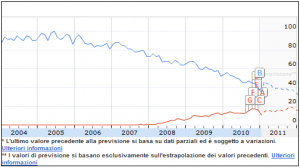
Open source is now the maturity phase, and it is interesting to look at how compares open source and cloud computing (courtesy of Google Insight for search).
But the open source world is not so small, looking at the same graph for different European countries makes a difference. While France looks at the cloud as much as North-Americans do, other countries (like Italy) are lagging behind (see also EC2 statistics).
Continue reading ‘The Open Source Year Ahead’
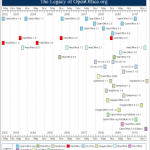
The legacy of OpenOffice.org and office migrations will be at the center of the next Open Source Focus Group meeting, to be held in Rome in January 2011.
In the meantime you might want to have a look at previous events - ranging from open source licensing to tenders and marketplaces - and presentations, all available on the new Focus Group Open Source blog hosted on WordPress.com.
“The Unsaid Document Foundation” series is disappointingly considered “fud” from LibreOffice developers, and Michael Meeks saying (again) that I made some good points, calls me a non-developer, probably to infer that I am not the best person to make programming suggestions.
Commercial open source blog readers care little to know about my computer science degree, or how much code I have been writing on a PDP-11 system. Therefore I would rather spend the rest of this blog entry sharing more thoughts about LibreOffice future.
Continue reading ‘The Unsaid Document Foundation (more talkbacks)’
Michael Meeks, famous hacker and LibreOffice advocate, replied to my earlier post giving his perspectives on many different subjects related to LibreOffice development.
Having read his views with great attention - and keeping in mind his long coding experience with OpenOffice.org, as well as his ability to dig deep into complex subjects like copyright assignment – I want to take a chance to go deeper into some points.
Continue reading ‘The Unsaid Document Foundation (talkbacks)’
The will be Document Foundation is out from a month, and it is now time to share some thoughts about past, present and future actions taken around subjects like copyright, the legal and governance structure and the code development process.
Continue reading ‘The Unsaid Document Foundation’
OpenOffice.org went live just ten years ago, on the 13rd of October 2000.Having been a community member for over 8 years, it is a good chance to recap what I have done until now. Continue reading ‘OpenOffice.org 10th Anniversary: 8 Years in Retrospective’
LibreOffice is born, and if it is true that every end is a new begin is too early to tell if this is a good or a bad thing.
Let’s start by looking at the foundations of this brand new Document Foundation.
The Steering committe, created by cooptation by eminent contributors and project lang mantainers, has already made some choices, and until now the ‘community’ behind OpenOffice.org had no chance to join the debate.
The FAQ page itself doesn’t say much about the governance model, while a number of open source thought leaders have been welcoming the news.
How many vendors beyond Novell will eventually join the foundation and put their money (time) where their mouthes are?
Ultimately an open source community is made of developers and users, and also the latter play an important role, especially for end-users applications.
How will users take to these changes?
Few days ago I shortly mentioned the OpenOffice.org Hackfest, and today I asked my friend Florian Effenberger - OpenOffice.org Marketing Project Lead - to tell us more about the event, to be held on the 6-7 of November at the Attraktor in Hamburg. Continue reading ‘More about the OpenOffice.org Hackfest’
Recent Comments