Monthly Archive for April, 2008

Internet Governance Forum: Draft Programme for the 3rd Meeting (Hyderabad, 3-6 December 2008)

The third Internet Governance Forum (IGF) meeting will be held at Hyderabad on the 3-6 December 2008, a draft programme is available and open for discussion. Comments submitted to the IGF Website by 1 May will be reflected in a revised version that will be issued as a conference room paper at the consultations on 13 May.

1 Introduction

This paper aims to provide an input into the open round of consultations on 13 May 2008 to discuss programme and agenda for the third meeting of the IGF in Hyderabad. It gives a first draft programme outline, focusing on structure rather than content. The draft programme outline tries to make best possible use of the facilities that are available a..t the conference venue. It also takes into account the fact that participation at the first meetings in Athens and Rio de Janeiro exceeded expectations and that as many, if not more, people are expected to attend the Hyderabad meeting.

The paper is conceived a rolling document. Comments submitted to the IGF Web site by 1 May will be reflected in a revised version that will be issued as a conference room paper at the consultations on 13 May.

2 Basic structure for the Hyderabad meeting

The proposed meeting structure builds on the successes of the Athens and Rio de Janeiro meetings and takes into account the comments made in the stocktaking process, both on-line and at the meetings in Geneva on 26-28 February. As was the case in Rio de Janeiro, the Hyderabad meeting will not be merely repeating the structure of the inaugural meeting, but will have its own character and will go beyond the formats used previously. The informal, interactive multistakeholder format was generally seen as one of the key factors of the success of the first two meetings and should be maintained as a guiding principle. Participation will follow the format used at the previous meetings and all entities and persons with proven expertise and experience in matters related to Internet governance may apply to register as participants.

The basic format of the previous meetings, with main sessions and workshops, should be maintained. The five broad themes – access, openness, security, diversity, and critical Internet resources – will be retained but not necessarily as themes for the main sessions. The point was made that the general issues had been effectively covered during the previous two IGF meetings and that the sessions in Hyderabad should be more focused.

Technorati Tags: IGF, Internet Governance Forum, Hyderabad

Open Standards: Standards Organizations, how open are them? an Evaluation Methodology

IDC prepared a document for the Danish National IT and Telecom Agency (NITA) describing a methodology to evaluate Standard Setting Organizations (SSO) with regard to the degree of openness of the organization and thereby the degree of openness in their deliverables, i.e. standards.

IDC starting from the ten rights that enable open standards mentioned before, evaluated ten organizations -  CEN, Ecma, ETSI, IETF, ISO, ITU, NIST, OASIS, OMG, and W3C - and all organizations had the opportunity to review and comment on the evaluation of their organization. NITA specified 9 of Krechmer’s criteria, where the exclusion of “Open World” stems from the re-purposing of “Open Interface”, extended to covering both and accordingly renamed “Open Interoperability”.

IDC in conclusion states that there are differences between standard setting organizations in terms of “openness” and is implemented, concluding that it is difficult to make a distinction of which form of “openness” is the most appropriate. Continue reading ‘Open Standards: Standards Organizations, how open are them? an Evaluation Methodology’

Open Standards: Do Open Standards’ implementations meet their specifications?

IT vendors are not asked to prove that their software products are meeting open standardsspecifications. Declarations of conformity to a file format standard is a self-certification process.

My speech on the session entitled “Tomorrow’s data availability depends upon today’s data format“ at the OMAT conference was on standards conformance, an issue too often not considered.

In the European Economic Area the CE mark is a mandatory conformity mark for certain product groups to indicate conformity with the essential health and safety requirements set out in European Directives. In short you need a CE mark to sell a plug or a toy, but you can sell software without any external test house which evaluates the product and its documentation. At the end of the day there is no organization that assess standards compliance, we can just rely on implementors’ statements of compliance.

Ken Krechmer over the last ten years spent time and efforts to define the meaning of Open Standards, and he was the first to clearly explain the different views of all standards’ stakeholders.

It is common to think of standardization as the process of standards creation, but this view excludes those who implement the standard (implementers) and those who use the implementations of the standard (users).

Krechmer identifying each constituency’s view gives us a complete description of Open Standards emerge, and a key to understand what is in our interests. I introduced the OMAT’s audience to the ten rights that enable open standards using the following visual presentation.

(Either JavaScript is not active or you are using an old version of Adobe Flash Player. Please install the newest Flash Player.)

I went through all criteria, stressing the importance of some of them, like the “Open Meeting” one, establishing that all stakeholders can participate. A right not addressed by many Standard Specification Organizations like ISO, OASIS and W3C, all having in place a pay-to-become-a-member policy.

“Open Documents”, the right to see any documents from a Standard Specification Organization included individual technical proposals and meeting reports, is a standardization right connected to Open Meeting. It come no surprise that the transparency of a meeting is related to the availability of all the documents from the meeting. Again, ISO and other organizations do not fulfill this right.

I stressed also the importance of “Open Change”, the right that gives the ability to prevent predatory practices through license terms that protect against subversion of the standard by embrace and extend tactics.

Last but not least “Open Use” identifies the value of conformance for implementers and users. While multiple implementers can gather together to check if their implementations work with each other (plug-fest), users do need a formal entity taking care of the conformance process. Apparently ETSI is a candidate, it is up to you to judge whether it is a good or a bad thing.

Note that only when all ten rights are supported will standards be really open to all.

Technorati Tags: KenKrechmer, Open Standards, predatory practices, SSO, standardization body, file format

Open Source Education: Progress of Free Software in Russian Schools

Not much has been heard after a loud announcement last autumn that Russia is going to migrate its secondary education to a Free Software operating system developed locally. There have been many announcements of this kind in past, and only few of them eventually led to some worthwhile results. For example, China’s Jiangsu deployment of Linux in secondary education was deemed to be the largest in history, but the feedback gained from it was so poor (only few messages were posted in the online forum that was taken down eventually) that there is almost no doubt as to the outcome of this project. It could have played its role, however, in trading China’s deal with Microsoft that now allows students in China to legally buy Windows+Office bundles for only $3.

And what about Russia? Maybe the school project is just another example of someone’s ungrounded ambitions and poorly made estimates? It may be too early to say for sure, but there is already some evidence that the project will not remain unfruitful.First of all, first deliverables have already become available. Openly and publicly (Russian). Among others, you are able to download the specially tailored Linux distributions, including a version tailored for older PCs with 128-256 MB of RAM and P-233-class CPUs and a Terminal Server edition that allows to use older PCs as thin terminals provided a decent server is available in the classroom.Secondly, the information is now coming from more than one source, which indicates that the regional participants of the project have both freedom and willingness to act (Perm, Tomsk, Moscow, all in Russian). The most curious is the website of the Perm region, where a map of the integration progress is available. The numbers in black correspond to the total amount of schools (first number is for city/town schools, second is for rural schools), the numbers in red correspond to the schools where Free Software is already being used.

And what do the teachers say? The forum threads devoted to FOSS usage in schools are numerous, and are thus hard to summarize. Those of the teachers who are FOSS proponents are enthusiastic, and they try to reaffirm their position by pointing to the work that is being done by the Armada consortium and ALT Linux in particular as its most visible participant. The attitude of their colleagues varies from reserved support to skepticism, which sometimes comes from their inability to make computer peripherals work properly under Linux, and sometimes from the belief that the Microsoft monopoly is unbreakable.

Are these skeptics wrong? We will see by the end of 2008.

Technorati Tags: open source education, ALT Linux, Armada Consortium

OpenOffice.org: OOoCrackz, an Italian Extension to get in the Piracy Market

PLIO, the OpenOffice.org Italian Native-Lang Project association, announces the availability of OOoCrackz, an Extension that allow users to use the free and open source suite in a “crack mode”. The extension aims at answering the needs of 51% of the Italian market, that is in the hands of pirates.

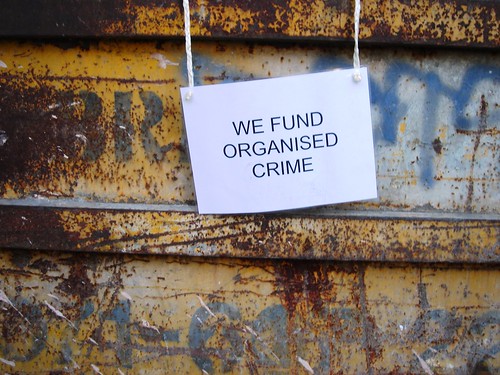
Funding Software PiracyWe fund organized Crime by dontaskme

Davide Dozza, PLIO’s President, explains why the Italian association decided to develop OOoCrackz:

Reading “The Economic Benefits of Lowering PC Software Piracy“, an IDC research sponsored by the Business Software Alliance, we understood that OpenOffice.org license represents an obstacle to the adoption of he suite for about half of the Italian population, actually using mostly pirate software.

OOoCrakcz takes away three out of four freedoms, making illegal the access to the source code, the freedom to modify the code and redistribute it, just as every other proprietary software.

OOoCrackz has been developed by a PLIO’s member, Paolo Mantovani, one of the most known expert on OpenOffice.org macros and extensions expert:

The first release of extension allows only the activation of the “illegal mode”, but we are working on an evolution of the extension that will prevent you from releasing documents under Creative Commons licenses. The risk to manage is that the user could inadvertidly respect the copyright law.

To provide you with a real experience of using a pirate software, OOoCrackz prevents the registration and block all possible updates. The idea behind such choice is to make soon your copy obsolete, eventually exposing the user to security problems as happens with illegal copies.

Italo Vignoli, PLIO’s Marketing and Communication Manager stated:

The PLIO annual assembly announced marketing initiative to improve OpenOffice.org penetration in the Italian market. With this announcement we are targeting the illegal software market, a segment not yet addressed by our offer. This will reflect in our coverage of the market, and therefore we foresee an increase of our market share.

Technorati Tags: OpenOffice.org, OpenOffice, DavideDozza, PaoloMantovani, ItaloVignoli, OOoCrackz, Piracy Market, IDC, BSA


About the Editor

Roberto Galoppini on Open Source Software
Roberto has over 20 years experience in the computer industry, and has spent the last 10 years working in the intersection of open source software and business development. Roberto has taken an active interest in different open source projects and organizations, he also served on some advisory boards, and helped large IT vendors, open source vendors and customers to design and deploy their open source strategies. He works at SourceForge, and opinions expressed here don't necessarily represent employer's positions, strategies, or opinion.