

European Open Source Projects: Qualipso Conference (part II)
The second day of The First International QualiPSo conference – “Boosting innovation and growth by fostering Open Source Software trust and quality” – I arrived just in time to attend the “Legal issues in OSS” debate, moderated by Stéphane Dalmas (INRIA).
 The end or a new beginning? by kreativekell
Stéphane insistently asked the panelists why Europe should accept what he called “US-centric FOSS licenses”, eventually ending to let the audience yawn at the second question on the same topic. I bring some statistics on the table, saying that roughly 75% percent of open source software, at least on SourceForge, is released under GPL/LGPL (of which about 65% under GPL), and I don’t see the point to create a (European) license when EU is definitely not a software house.
I also asked Till Jaeger, of JBB Law in Germany and one of the driving forces behind the Institut für Rechtsfragen der Freien und Open Source Software, if the AGPL was going to take over in his opinion, at least among small European OS firms. Till represented FSFE in Germany and Harald Welte in GPL enforcement cases, and he said that among the local firms he is advicing AGPL is an emergent phenomenon.
Last but not least Phil Robb introduced the audience to HP vision to setup methodologies, process and tools to manage licenses’ complexity.
The following forum – “Business models and strategies†session – was moderated by Franz Kurdofer, Principal Consultant at Siemens, who opened the session saying that QualiPSo future work would be to recommend the best open source strategies depending on selected business models.
Jean-Noel de Galzain, CEO of Wallix, started apologizing because, he said, he had to set up his presentation in the ten minutes he had before. His speech basically was about Wallix, a promising European OS firm I didn’t know before, but we lost the chance to hear from his voice a definitely much more interesting story.
Diego Lo Giudice, Principal Consultant at Forrester, being the only analyst among the panelists was supposed to be the keynote speech of the session. His taxonomy of open source business models was basic [slide 19] (SaaS, Product Focused, Service Focused) and filled with inaccuracies, such as listing OpenLogic among SaaS-based firms or citing Funambol’s ten million downloads mark (a number I really wish Fabrizio to reach before doomsday!). He eventually closed his speech with a slide about real truth about the future beyond 5+ years, displaying only a big ‘?’.
Do we have to think that Forrester analysts have no idea of what will be the possible evolution of the OSS market? This may explain why just a few years ago most of the consulting firms were convinced that OSS was a “flash in the pan” and would have never reached significant market share…
Björn Lundell, chairman of the Open Source Sweden, a one-year old industrial Swedish Open Source Association, showed a slide [30] relating “commodification” of FOSS, ranging from not differentiating to differentating, to cooperation, from intra company to inter company.
Cédric Thomas, CEO of the OW2 Consortium, talking about productized services said that the subscription is a healthy market, and that despite there is a lot of traction for SaaS he doesn’t see it replacing the dominant purchase and license mode.
I asked the panelists about the Sun-MySQL deal, and I noticed that none of them spoke about open source business models, mentioning only specific aspects like licensing. The result was that the company’s strategy, or how a specific firm differentiates itself and deals with the competition, was not effectively described, neither understood.
Jean-Pierre Laisné, Bull, formerly Chairman of the Board for the ObjectWeb Consortium, moderated the last forum “A network of OSS competence Centres“. He was the only one conducting the session proactively, posing interesting questions to the panelists and doing so eventually catching the audience attention.
Petri Räsänen, President of COSS, one of the oldest European FOSS competence centers, stated:
Are you trying to create a compentence center from scratch? It takes years!
Petri said that the COSS is stimulating FOSS firms to work together with a common “vertical” goal, agreeing with me about the importance of avoiding horizontal aggregation of firms. In this respect I suggested Jean-Pierre to look deeper into the horizontal vs vertical debate, considering the lack of information about consortia and associations in QualiPSo’s deliverables.
I asked Marco Fioretti, Linux Journal Editor, a comment about the conference:
In several moments the conference sounded to me like some LinuxWorld show of 6/7 years ago; sure, OSS is a very smart business strategy both for producers and corporate users, but we already knew it and even Qualipso knows it. Personally, however, I have the feeling that Dana Blankenhorn is right when he says that this may be the best way to make EU officially accepts OSS as soon as possible. I’m not necessarily happy about it, of course…
(Just to recall, Dana wrote “the insights aren’t that deep. They don’t seem to be much more than what you would get from an hour’s worth of Googling.”)
Summarising:
- Considering that QualiPSo aims at facilitating the reusability of the results of the project to let the QualiPSo competence centers able to deliver consultancy services on FOSS based business models, a better understanding of business models is a must;
- Getting involved people from FOSS communities is also a must, especially to avoid self-referentiality. Talking about OSS and not presenting what self-sustaining communities (like Debian or KDE) are doing restrict the range of observed phenomenons (consider that half of the linux kernel is community-developed…)
. - While it is encouraging to know that the Commission is investing quite a lot in OSS, it seems that smaller and more focused projects have obtained in the past (and are obtaining now) more “bang for the buck”.
. - Up to now, most competence centers across EU have demonstrated little impact on the creation of a regional/national OSS market. What Qualipso is doing in improving the situation?
- For your next conference, organize your roundtables so every panelist has the opportunity to show its true competences…
 Roberto Galoppini,
 Davide, and 1 other are discussing.


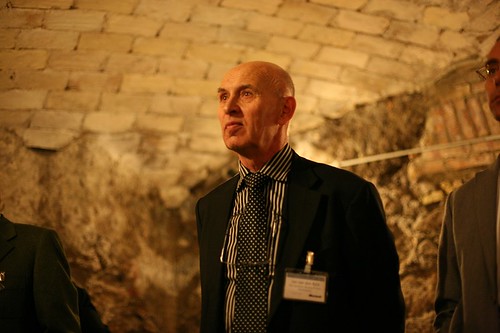 Jan van den Beld by
  Remember how it all began.. by
Pay attention to the legal session…. Phil Robb did not attend the conference… probably you are speaking about Martin Michlmayr…